

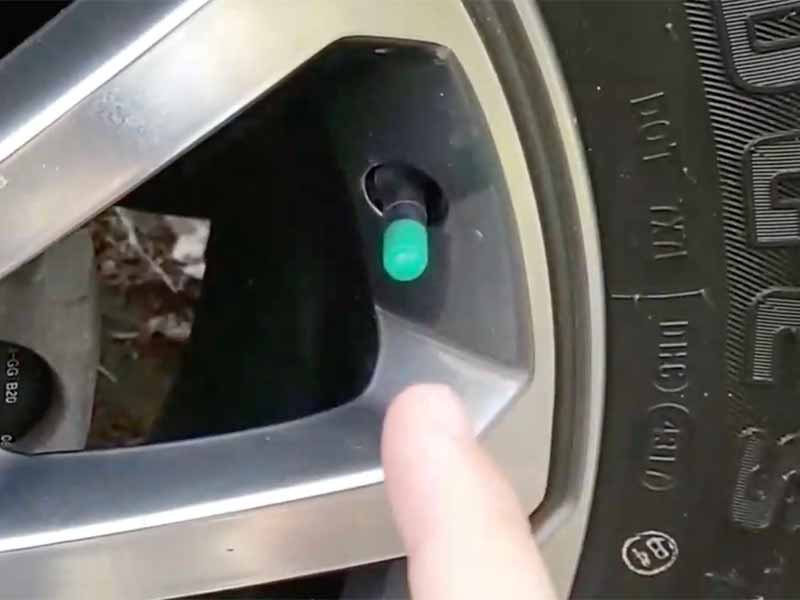
Green valve stem caps mean your tires are filled with nitrogen instead of regular compressed air. The color is an industry convention — if a tire shop fills your tires with nitrogen, they replace the standard black plastic cap with a green one as a visual indicator for anyone who might later check or adjust the pressure.
That’s all the green cap means. Nothing about the tire itself is different — same tire, same wheel, same pressure spec. The only thing that’s changed is what gas is inside.
This guide explains what nitrogen actually does for your tires (small benefits in pressure stability), what the marketing claims overstate, and what to do when you need to top off the air at a station that doesn’t offer nitrogen.
Why Tire Shops Use Green Caps
The green cap is purely a flag. It tells:
- The next shop or mechanic who checks pressure that the tire is nitrogen-filled, so they can use a nitrogen source to top off (or know that adding regular air will dilute the nitrogen).
- You, the owner, that you paid for the nitrogen service and the tire’s still on it.
- The shop itself, if you come back, that they’re the ones who filled it.
That’s it. Green caps aren’t a special tire technology, a tire-pressure-sensor system, or anything mechanical. Black caps work exactly the same way physically — they’re just the default color the cap manufacturer ships in.
What Nitrogen Actually Does
Regular air is about 78% nitrogen and 21% oxygen, with trace amounts of other gases and (importantly) water vapor. When tire shops “fill with nitrogen,” they’re using nitrogen at about 95% purity, which displaces most of the oxygen and water vapor that would otherwise be in the tire.
The differences nitrogen actually makes:
- Slightly more stable pressure with temperature changes. Nitrogen molecules and water-vapor-containing air expand at slightly different rates with heat. Nitrogen is more stable. Real-world impact for a passenger car: usually less than 1 PSI difference over a 50°F swing.
- Slightly slower permeation through rubber. Oxygen molecules are smaller than nitrogen molecules and slip through the tire’s rubber walls slightly faster. A nitrogen-filled tire might lose 1–2 PSI per month instead of the 2–3 PSI a regular-air tire loses. Net difference: maybe one fewer top-off per year.
- Less internal moisture. Without water vapor inside the tire, there’s no condensation against the inside of the rim, which means slightly less rim corrosion over the life of the tire. This matters most in commercial/fleet applications where wheels are reused many times.
What Nitrogen Doesn’t Do
The marketing for nitrogen often promises more than it delivers. The claims that don’t hold up:
- “Better fuel economy.” Only if regular-air drivers chronically run their tires underinflated. If you check your pressure monthly and keep tires at spec, you’ll see no fuel-economy difference between nitrogen and regular air.
- “Longer tire life.” The slower oxidation-of-rubber-from-inside effect is real but tiny — nowhere near big enough to extend tire life by months or years in normal use. The 6-year tire age limit applies to nitrogen-filled tires too.
- “More predictable handling.” Pressure differences between nitrogen and regular air are too small to be felt by the driver in any practical situation.
- “Safer at high speed.” Nitrogen is what F1 and aircraft tires use, true. But those are extreme cases — F1 tires hit 200°F+ during a race, aircraft tires deal with massive temperature swings from ground to altitude. Your daily commuter operates in a much narrower range where regular air works fine.
Is Nitrogen Worth Paying For?
For most passenger car drivers, no. The benefits are real but small (1 fewer PSI top-off per quarter, maybe), and the cost is typically $5–$10 per tire for the initial fill plus $2–$5 per tire to top off afterward. Over the life of a set of tires, you’re spending $80–$150 on nitrogen for benefits you’d struggle to measure.
The exceptions where it does make sense:
- If a dealer or tire shop is offering it free. Costco, some Discount Tire locations, and some Toyota and Honda dealers include free nitrogen with new tire purchases. If the price is zero, sure — the small benefits still apply.
- If you genuinely never check pressure. Slightly slower permeation means slightly longer between problems. Still not a substitute for actually checking pressure, but it lengthens the runway.
- If you run dedicated track or autocross tires. The temperature stability matters more when tires hit 180°F+ during hard driving. Track-day drivers often use nitrogen for this reason.
- If you store a vehicle long-term. Nitrogen’s slower permeation matters more on tires that won’t be driven (and topped off) for months at a time.
Topping Off Nitrogen-Filled Tires with Regular Air
If you have nitrogen-filled tires (green caps) and you need to add air at a station that only offers regular compressed air, just add the regular air. The tire still works perfectly; you’ve just diluted the nitrogen with regular air slightly. Each top-off reduces the nitrogen percentage incrementally.
- The tire doesn’t care. Air pressure is air pressure, regardless of which gas mix produces it.
- You’ll lose the “pure nitrogen” status over time. After a few top-offs with regular air, the mix in your tire is closer to regular air than to pure nitrogen. The marginal benefits of nitrogen get correspondingly smaller.
- You can keep the green caps or switch to black. Both work. If you’ve topped off enough times that you’re no longer really running nitrogen, the green cap is just decoration — you can swap to standard black caps if you want.
- Some shops will refill with pure nitrogen for a small fee ($5–$10 per tire) if you want to “re-pressurize” with nitrogen after a few regular-air top-offs.
Other Cap Colors
While green is the most common non-black cap color, you may occasionally see others:
- Blue: sometimes used for nitrogen by certain shops or for aftermarket sport caps. Not as standardized as green.
- Red, yellow, etc.: usually purely decorative aftermarket caps. No technical meaning.
- Metal caps with built-in pressure indicators: these change color (or display a number) based on tire pressure. Useful for at-a-glance checking but not an industry standard color code.
Bottom Line
Green valve stem caps mean nitrogen-filled tires. The benefits are real but small — slightly more stable pressure across temperature changes, slightly slower air loss through the rubber, slightly less internal moisture. None of these are large enough to justify paying for nitrogen unless it’s free with your tires or you have a specific use case (track driving, long-term storage).
If you do have nitrogen-filled tires, you can safely top off with regular air at any gas station. You’ll slowly dilute the nitrogen percentage, but the tire works the same either way. The most important factor for your tires’ longevity is still keeping them at the correct pressure — regardless of which gas is inside.