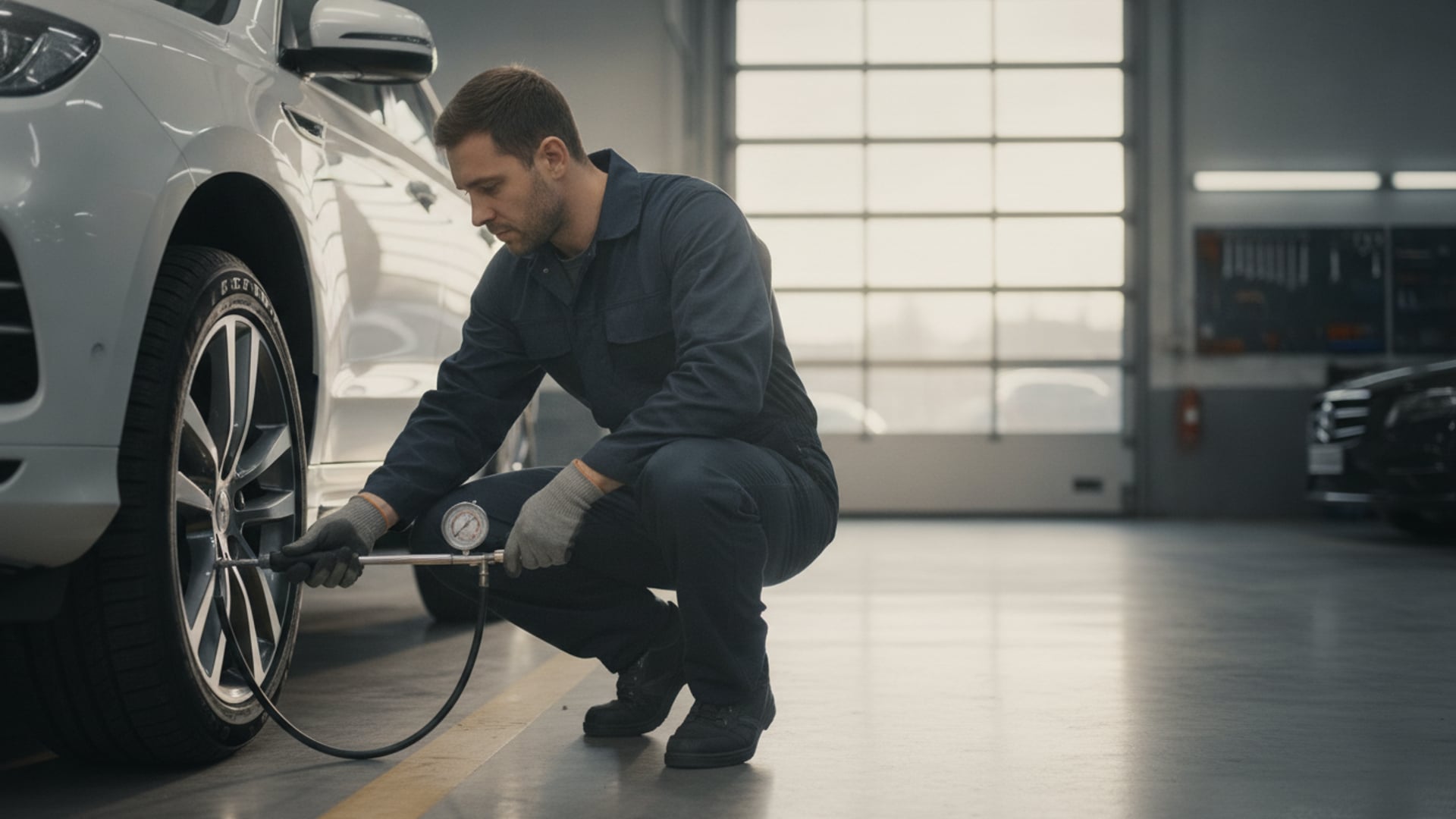
A mechanic checking tire pressure on the front wheel of a white SUV with a pressure gauge in a service garage

How Close to Max PSI Should Your Tires Be?


 |  Last Updated:

Jun 24, 2026 @ 9:39 pm

Time To Read:

6 minutes

 |  Last Updated:

Jun 24, 2026 @ 9:39 pm

Time To Read:

6 minutes

The max PSI printed on your tire’s sidewall is an upper limit, not a target. It’s the pressure the tire is rated to hold safely — the structural ceiling of what the carcass and bead can take without failing. Your recommended pressure is a different number entirely, and it’s almost always significantly lower.

For most passenger cars and SUVs, recommended pressure is between 30 and 35 PSI, while sidewall max is typically 44 to 51 PSI. That gap exists on purpose. The recommended pressure is calibrated to your specific vehicle’s weight, suspension geometry, and tire size to give you the best balance of ride quality, traction, fuel economy, and tread wear. Running at or near the sidewall max compromises all four of those.

This guide explains where to find your real recommended pressure, when you might want to run slightly above it, why running at max is a bad idea, and what happens to your tires and vehicle if you do.

The Quick Answer

  • Use the pressure on the driver’s door jamb sticker, not the sidewall max. This is the figure your vehicle manufacturer specified for your specific car, tire size, and load.
  • The sidewall max is an absolute ceiling. Never exceed it. But you should rarely if ever run at it.
  • If you’re towing or hauling near the vehicle’s max load: add 3–5 PSI above the door-jamb spec, but stay below sidewall max.
  • Check pressure cold — first thing in the morning before driving, or after the car has sat for at least 3 hours. Tires gain 3–5 PSI as they heat up during driving, and the spec is the cold pressure.

Where to Find Your Real Recommended Pressure

The driver’s door jamb sticker is the authoritative source. Open the driver’s door and look at the B-pillar (the metal pillar between the front and rear doors) or sometimes the door itself. You’ll see a small white or yellow placard with:

  • Front tire pressure (cold)
  • Rear tire pressure (cold) — sometimes different than front, especially on trucks and minivans
  • Spare tire pressure
  • Tire size the vehicle was designed for
  • Max vehicle weight (GVWR)

This sticker is your authoritative spec. If you’ve moved to a non-stock tire size or load range, the door jamb pressures may need adjustment — ask your tire shop. Otherwise, set to these numbers and check monthly.

Why You Should Not Run at the Sidewall Max

Center Tread Wear

Overinflated tires don’t sit flat against the road. The excess pressure crowns the tread, putting more of the vehicle’s weight on the center strip and less on the edges. Over thousands of miles, you’ll see visible center wear — the center 1–2 inches of the tread bald out while the edges still have plenty of life. The tire ends up needing replacement with 30–40% of its potential life wasted.

Harsh Ride Quality

The tire is a primary part of your suspension. It absorbs small impacts that the springs and shocks aren’t designed to handle. An overinflated tire is stiffer and absorbs less, transmitting bumps, expansion joints, and road texture into the cabin more aggressively. The car feels worse over the same roads it always handled fine on.

Reduced Wet Traction

A tire’s grip in rain depends on getting the entire tread surface into contact with the road. When the contact patch is crowned to the center, the edges aren’t doing their share of the work. Hydroplaning risk increases. Wet stopping distance gets longer. You don’t notice it on a dry day, but the first heavy rain you drive in reveals it.

Vulnerability to Impact Damage

When You Should Run Slightly Above the Recommended PSI

  • Heavy loads or towing. Add 3–5 PSI to the rear tires (or wherever the load sits) when you’re near the vehicle’s max payload or towing capacity. Higher pressure prevents excessive sidewall flex under load, which would otherwise overheat the tires. Drop back to the door-jamb spec once the load is off.
  • Sustained high-speed driving. Long stretches at 80+ mph (track day, autobahn-style highway) generate more heat than recommended pressures account for. Adding 2–3 PSI helps stabilize the tire under sustained load. Drop back after the high-speed driving is done.
  • Cold weather adjustment. Tire pressure drops about 1 PSI for every 10°F drop in temperature. If your door-jamb spec is set assuming moderate weather and you’re in a sustained cold snap, top up to spec rather than running 4–5 PSI below it. Don’t overshoot.

In all three cases, the adjustment is small (3–5 PSI above spec, not anywhere near sidewall max) and temporary. The door-jamb spec is the default for everyday driving.

Why the Sidewall Number Exists at All

The number molded into the sidewall (e.g., “Max Press 44 PSI”) is the maximum pressure the tire is rated to safely hold while carrying its maximum rated load. It’s a regulatory and engineering ceiling — the manufacturer is telling you “beyond this, we can’t guarantee the structure holds.”

It’s intentionally generous. The same tire model goes on hundreds of different vehicles, from small sedans to heavy SUVs, and the sidewall max has to accommodate the heaviest possible application. Your specific vehicle uses a fraction of that capacity. The door-jamb spec is the manufacturer translating “the tire can handle 44 PSI” into “for this specific car, run 32 PSI to get the best handling, ride, and tread life.”

Common Misconceptions

  • “Higher pressure means better fuel economy.” Slightly true at the margins, but the effect is small (1–2% at most), and the cost in tread life and ride quality is much larger. Running 2–3 PSI above spec for fuel economy is a bad trade.
  • “Max PSI means the tire can’t go higher.” The tire actually can hold significantly more pressure than the rated max — the safety margin is built in. But running above max voids warranties and increases failure risk over time. Don’t.
  • “Underinflated tires are dangerous; overinflated tires are safe.” Both are bad. Underinflation causes edge wear, overheating, and blowouts. Overinflation causes center wear, harsh ride, and impact vulnerability. The door-jamb pressure is the middle ground for a reason.
  • “My TPMS doesn’t warn me, so I’m fine.” TPMS only warns when pressure drops about 25% below spec — usually 7–10 PSI low. By the time it triggers, you’ve been driving on dangerously underinflated tires for a long time. Manual monthly checks catch the problem earlier.

Bottom Line

Your tire’s sidewall max PSI is a ceiling, not a target. Your real recommended pressure lives on the driver’s door jamb sticker and is almost always 10–15 PSI below the sidewall max. Run to the door jamb. Check monthly. Adjust 3–5 PSI up only for heavy loads or sustained high-speed driving, and drop back down afterward.

Running at or near the sidewall max produces a tire that wears unevenly in the center, rides harshly, grips worse in the rain, and bruises more easily on potholes. The “safe” extra pressure costs you in every other dimension of how the tire is supposed to perform.

Related Guides

About The Author

Will Creech
Will Creech

Will Creech is the founder of TireGrades.com and has been immersed in the tire industry for over three decades. His expertise was shaped by growing up alongside the founder of Parrish Tire in Charlotte, NC, and later honed through a consulting contract with Discount Tire, where he developed training courses and strategic planning materials.

An active SCCA participant and lifelong automotive enthusiast, Will personally researches, writes, and produces every review on TireGrades — including 300+ companion video reviews on YouTube. His approach combines aggregated real-world owner data with deep industry knowledge to help drivers find the right tire at the right price.

YouTube Icon
LinkedIn icon
YouTube Icon
LinkedIn icon

The max PSI printed on your tire’s sidewall is an upper limit, not a target. It’s the pressure the tire is rated to hold safely — the structural ceiling of what the carcass and bead can take without failing. Your recommended pressure is a different number entirely, and it’s almost always significantly lower.

For most passenger cars and SUVs, recommended pressure is between 30 and 35 PSI, while sidewall max is typically 44 to 51 PSI. That gap exists on purpose. The recommended pressure is calibrated to your specific vehicle’s weight, suspension geometry, and tire size to give you the best balance of ride quality, traction, fuel economy, and tread wear. Running at or near the sidewall max compromises all four of those.

This guide explains where to find your real recommended pressure, when you might want to run slightly above it, why running at max is a bad idea, and what happens to your tires and vehicle if you do.

The Quick Answer

  • Use the pressure on the driver’s door jamb sticker, not the sidewall max. This is the figure your vehicle manufacturer specified for your specific car, tire size, and load.
  • The sidewall max is an absolute ceiling. Never exceed it. But you should rarely if ever run at it.
  • If you’re towing or hauling near the vehicle’s max load: add 3–5 PSI above the door-jamb spec, but stay below sidewall max.
  • Check pressure cold — first thing in the morning before driving, or after the car has sat for at least 3 hours. Tires gain 3–5 PSI as they heat up during driving, and the spec is the cold pressure.

Where to Find Your Real Recommended Pressure

The driver’s door jamb sticker is the authoritative source. Open the driver’s door and look at the B-pillar (the metal pillar between the front and rear doors) or sometimes the door itself. You’ll see a small white or yellow placard with:

  • Front tire pressure (cold)
  • Rear tire pressure (cold) — sometimes different than front, especially on trucks and minivans
  • Spare tire pressure
  • Tire size the vehicle was designed for
  • Max vehicle weight (GVWR)

This sticker is your authoritative spec. If you’ve moved to a non-stock tire size or load range, the door jamb pressures may need adjustment — ask your tire shop. Otherwise, set to these numbers and check monthly.

Why You Should Not Run at the Sidewall Max

Center Tread Wear

Overinflated tires don’t sit flat against the road. The excess pressure crowns the tread, putting more of the vehicle’s weight on the center strip and less on the edges. Over thousands of miles, you’ll see visible center wear — the center 1–2 inches of the tread bald out while the edges still have plenty of life. The tire ends up needing replacement with 30–40% of its potential life wasted.

Harsh Ride Quality

The tire is a primary part of your suspension. It absorbs small impacts that the springs and shocks aren’t designed to handle. An overinflated tire is stiffer and absorbs less, transmitting bumps, expansion joints, and road texture into the cabin more aggressively. The car feels worse over the same roads it always handled fine on.

Reduced Wet Traction

A tire’s grip in rain depends on getting the entire tread surface into contact with the road. When the contact patch is crowned to the center, the edges aren’t doing their share of the work. Hydroplaning risk increases. Wet stopping distance gets longer. You don’t notice it on a dry day, but the first heavy rain you drive in reveals it.

Vulnerability to Impact Damage

When You Should Run Slightly Above the Recommended PSI

  • Heavy loads or towing. Add 3–5 PSI to the rear tires (or wherever the load sits) when you’re near the vehicle’s max payload or towing capacity. Higher pressure prevents excessive sidewall flex under load, which would otherwise overheat the tires. Drop back to the door-jamb spec once the load is off.
  • Sustained high-speed driving. Long stretches at 80+ mph (track day, autobahn-style highway) generate more heat than recommended pressures account for. Adding 2–3 PSI helps stabilize the tire under sustained load. Drop back after the high-speed driving is done.
  • Cold weather adjustment. Tire pressure drops about 1 PSI for every 10°F drop in temperature. If your door-jamb spec is set assuming moderate weather and you’re in a sustained cold snap, top up to spec rather than running 4–5 PSI below it. Don’t overshoot.

In all three cases, the adjustment is small (3–5 PSI above spec, not anywhere near sidewall max) and temporary. The door-jamb spec is the default for everyday driving.

Why the Sidewall Number Exists at All

The number molded into the sidewall (e.g., “Max Press 44 PSI”) is the maximum pressure the tire is rated to safely hold while carrying its maximum rated load. It’s a regulatory and engineering ceiling — the manufacturer is telling you “beyond this, we can’t guarantee the structure holds.”

It’s intentionally generous. The same tire model goes on hundreds of different vehicles, from small sedans to heavy SUVs, and the sidewall max has to accommodate the heaviest possible application. Your specific vehicle uses a fraction of that capacity. The door-jamb spec is the manufacturer translating “the tire can handle 44 PSI” into “for this specific car, run 32 PSI to get the best handling, ride, and tread life.”

Common Misconceptions

  • “Higher pressure means better fuel economy.” Slightly true at the margins, but the effect is small (1–2% at most), and the cost in tread life and ride quality is much larger. Running 2–3 PSI above spec for fuel economy is a bad trade.
  • “Max PSI means the tire can’t go higher.” The tire actually can hold significantly more pressure than the rated max — the safety margin is built in. But running above max voids warranties and increases failure risk over time. Don’t.
  • “Underinflated tires are dangerous; overinflated tires are safe.” Both are bad. Underinflation causes edge wear, overheating, and blowouts. Overinflation causes center wear, harsh ride, and impact vulnerability. The door-jamb pressure is the middle ground for a reason.
  • “My TPMS doesn’t warn me, so I’m fine.” TPMS only warns when pressure drops about 25% below spec — usually 7–10 PSI low. By the time it triggers, you’ve been driving on dangerously underinflated tires for a long time. Manual monthly checks catch the problem earlier.

Bottom Line

Your tire’s sidewall max PSI is a ceiling, not a target. Your real recommended pressure lives on the driver’s door jamb sticker and is almost always 10–15 PSI below the sidewall max. Run to the door jamb. Check monthly. Adjust 3–5 PSI up only for heavy loads or sustained high-speed driving, and drop back down afterward.

Running at or near the sidewall max produces a tire that wears unevenly in the center, rides harshly, grips worse in the rain, and bruises more easily on potholes. The “safe” extra pressure costs you in every other dimension of how the tire is supposed to perform.

Related Guides

About The Author

Will Creech
Will Creech

Will Creech is the founder of TireGrades.com and has been immersed in the tire industry for over three decades. His expertise was shaped by growing up alongside the founder of Parrish Tire in Charlotte, NC, and later honed through a consulting contract with Discount Tire, where he developed training courses and strategic planning materials.

An active SCCA participant and lifelong automotive enthusiast, Will personally researches, writes, and produces every review on TireGrades — including 300+ companion video reviews on YouTube. His approach combines aggregated real-world owner data with deep industry knowledge to help drivers find the right tire at the right price.

YouTube Icon
LinkedIn icon
YouTube Icon
LinkedIn icon