

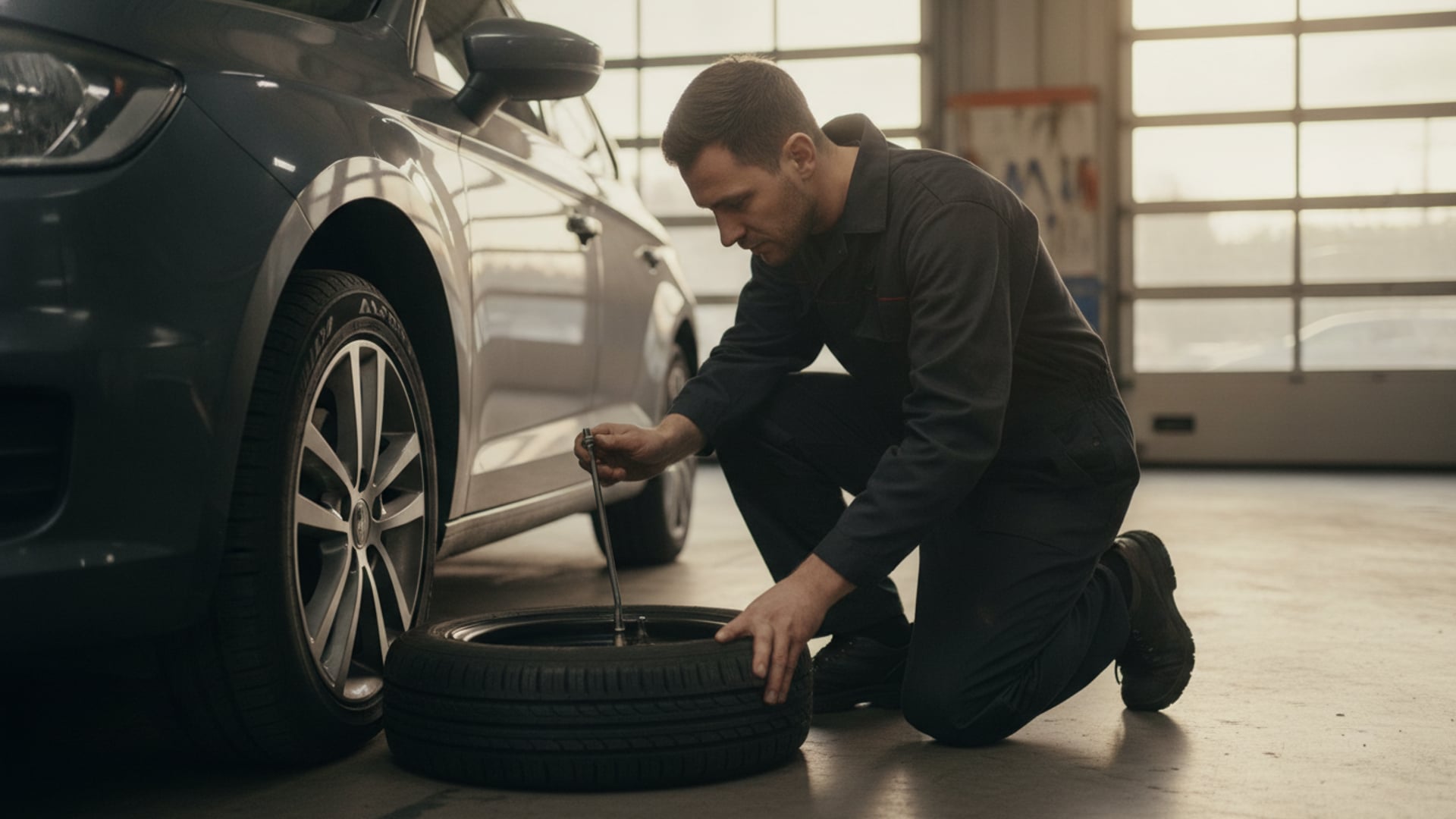
If air won’t go into your tire, the cause is almost always one of six things: a stuck valve core, a cold-frozen valve stem, a compressor that doesn’t have enough output pressure to overcome what’s already in the tire, the tire bead has unseated from the rim, the chuck doesn’t fit the valve type, or there’s corrosion inside the stem blocking the seal.
Each cause has a distinct symptom. Air hisses out around the chuck instead of going in — that’s one problem. The compressor runs but the pressure doesn’t budge — that’s a different problem. The tire is completely flat and the chuck just hisses helplessly — that’s a third. Diagnose by what you’re seeing, then apply the right fix.
This guide walks through each of the six common causes, what to check, and what to do.
The Quick Diagnostic
- Air hisses out around the chuck (not into the tire): the chuck isn’t seated properly on the valve, OR your chuck doesn’t fit the valve type.
- Compressor runs but the gauge doesn’t move: stuck or jammed valve core. Air can’t get past it.
- Compressor sounds strained, pressure rises very slowly: the compressor is at the limit of its output pressure. Common with cheap 12V compressors trying to fill a high-pressure tire.
- Cold weather, tire is partially flat, air goes in for a second then leaks back out: the valve stem is frozen and not sealing properly when you remove the chuck.
- Tire is completely flat and chuck hisses helplessly: the bead has unseated from the rim. Air just leaks back out around the seal between tire and wheel.
- Older vehicle, valve looks corroded or green: internal corrosion inside the stem is blocking the air path.
1. Stuck Valve Core
The valve core is the small spring-loaded pin inside the valve stem. When you press a chuck onto the valve, the chuck pushes the pin in, opening the airway. If the core is jammed (debris, corrosion, or a stuck spring), the pin doesn’t open and no air can get through.
- How to confirm: press a small tool (the back of a tire pressure gauge often has a pin for this, or use a paperclip) directly onto the valve core pin. You should hear a brief hiss of air escaping if the core is functional but stuck. If you hear nothing, the core is fully blocked.
- How to fix: remove and replace the valve core. A valve core tool ($5–$10) unscrews the core; a replacement core costs about $1. Re-inflate after replacement.
- When to defer to a shop: if you don’t have the tool or don’t want to deal with it, any tire shop can replace a valve core in 5 minutes for under $10.
2. Frozen Valve Stem
In cold weather, moisture inside the valve can freeze, jamming the core or sealing surfaces. You’ll typically see this when checking pressure on a cold morning — you remove the chuck and air keeps escaping because the valve isn’t sealing back up.
- How to confirm: the problem only happens when temperatures are below freezing, and resolves when the vehicle is moved into a warmer environment for an hour.
- How to fix: warm the valve stem with your hands, a hair dryer, or by parking in a garage. Use isopropyl alcohol to disperse moisture if the problem is recurring.
- Prevention: keep valve caps screwed on tight. Caps keep water and dirt out of the valve stem in the first place.
3. Compressor Pressure Too Low
Air flows from higher pressure to lower pressure. If your compressor’s maximum output is 35 PSI and your tire is currently at 32 PSI, you’ll only be able to add a few PSI before the compressor stalls out. Cheap 12V tire inflators often have output limits below the pressure of a fully-inflated tire, so they can only top off slightly low tires.
- How to confirm: the compressor runs but pressure rises only slightly before the motor sounds strained or the pressure stops climbing.
- How to fix: use a higher-capacity compressor. Any home/shop compressor (60+ PSI output) will easily fill a passenger tire. Gas station compressors typically deliver around 125 PSI and have no trouble. Portable 12V compressors rated for at least 100 PSI work fine for car tires.
4. Bead Unseated from the Rim
The tire seals against the wheel at two circular “beads” — the inside edges of the tire that press against the inside lip of the rim. When a tire goes completely flat or sits flat for a long time, the bead can come off the rim. With the bead unseated, air leaks back out as fast as you put it in.
- How to confirm: look at where the tire meets the wheel. If you can see a gap, or the tire looks visibly droopy on one side, the bead has unseated.
- How to fix at a shop: a tire shop can reseat the bead using a high-volume compressor or a bead-seater tool. $20–$50.
- Roadside DIY option: sometimes a quick burst of high-pressure air can pop the bead back onto the rim. This is the situation where it’s worth getting the tire repaired or replaced rather than just re-inflated.
- Critical safety note: if you reseat a bead at home, watch out for the loud “bang” as it seats. Stand to the side, not in line with the tire.
5. Wrong Chuck for the Valve Type
Nearly all passenger vehicle tires use Schrader valves — the short, threaded valve with a spring-loaded pin. Most compressor chucks fit Schrader. But bicycles, some specialty wheels, and certain European bikes use Presta valves, which are skinnier with a screw-down top. A Schrader-only chuck won’t seal on a Presta valve and vice versa.
- How to confirm: the chuck visually doesn’t seat onto the valve. Air hisses constantly around the chuck and pressure doesn’t move.
- How to fix: for car tires, this is almost never the issue. If it happens, you may have aftermarket wheels with non-standard valves. A Presta-to-Schrader adapter ($3) lets a standard chuck work on a Presta valve.
6. Corroded Valve Stem
Rubber valve stems wear out and crack over years of exposure to UV, ozone, and road salt. Metal valve stems (common on alloy wheels with TPMS) corrode internally if water gets in. Either way, a corroded stem can block air flow or fail to seal when you remove the chuck.
- How to confirm: visible cracks in the rubber, green or white corrosion around the base of a metal stem, or air hissing from the stem itself even when no chuck is attached.
- How to fix: replace the valve stem. $15–$40 at a tire shop, requires the tire to be dismounted from the wheel. If you have TPMS sensors mounted to a metal valve, the sensor often gets replaced as a unit with the stem.
- Prevention: replace rubber valve stems every time you replace tires (most tire shops do this automatically). Inspect metal stems for corrosion when you have winter tires swapped on or off.
When to Just Go to a Shop
Some of these problems are 5-minute DIY fixes. Others (bead reseating, valve stem replacement, internal corrosion) require tools, tire dismounting, or expertise that’s not worth acquiring for a one-time problem. The threshold:
- DIY: stuck valve core, frozen valve, weak compressor, wrong chuck.
- Shop visit: unseated bead, corroded valve stem, anything where you can’t identify the cause after a few minutes of inspection.
A tire shop can diagnose and resolve any of these in under 30 minutes for $20–$50. If you have roadside assistance or AAA, a flat-tire callout often covers re-inflation attempts at no cost.
Bottom Line
If you can’t get air into a tire, the cause is one of six things. Diagnose by symptom: hissing around the chuck means wrong chuck or bad seal; no pressure rise means stuck valve core or weak compressor; air escapes back out when you remove the chuck means frozen or corroded valve; tire is completely flat and won’t hold air means the bead has come off the rim.
For everyday issues like stuck cores or weak compressors, fixing it yourself is straightforward. For anything that needs the tire dismounted (bead reseat, valve stem replacement, internal corrosion), it’s worth the $20–$50 to have a shop handle it.