
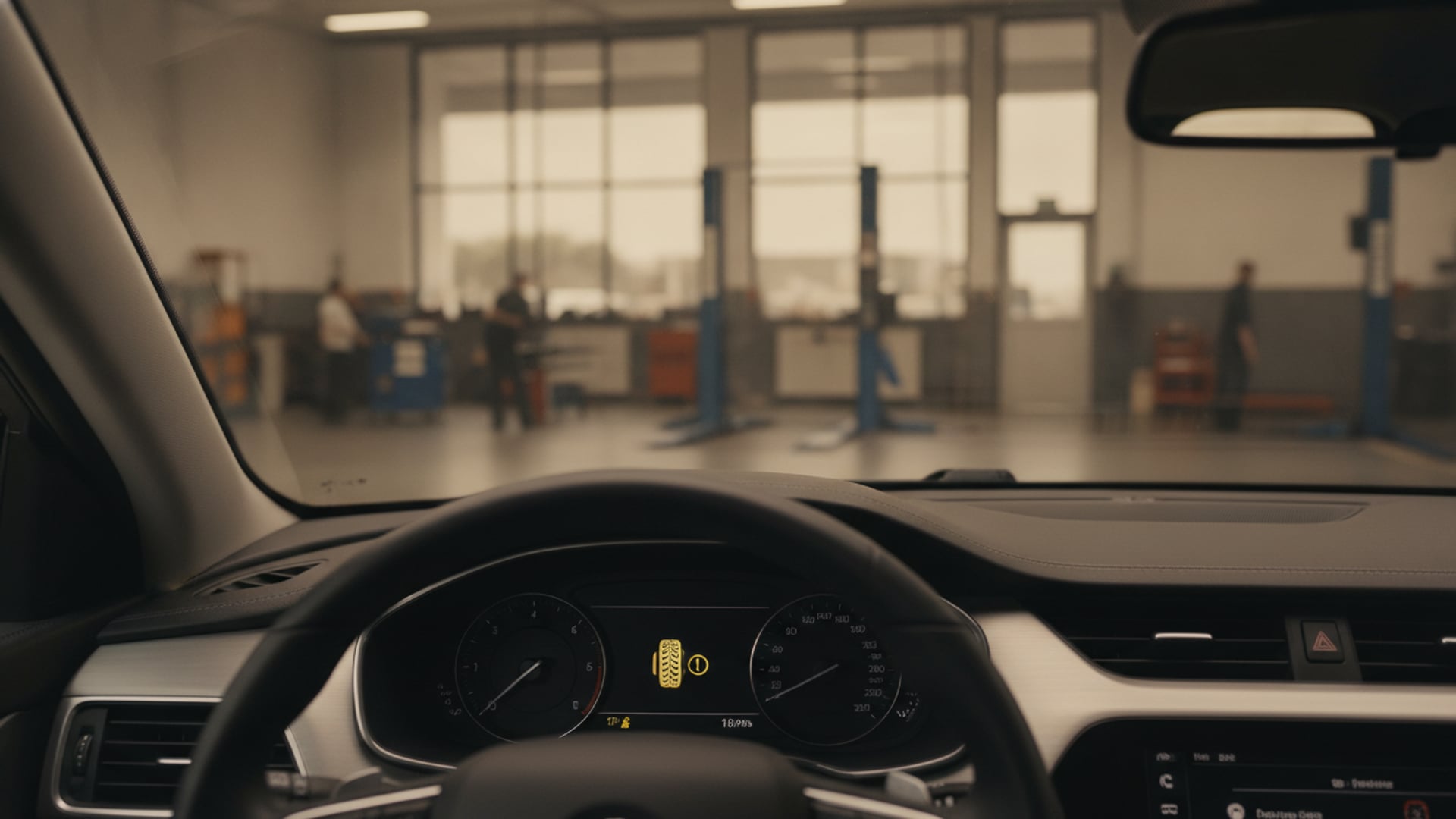
View from the driver's seat showing a yellow TPMS warning light illuminated on a car's dashboard

Tire Pressure Light Won’t Go Off? Here’s Why


 |  Last Updated:

Jun 24, 2026 @ 9:39 pm

Time To Read:

6 minutes

 |  Last Updated:

Jun 24, 2026 @ 9:39 pm

Time To Read:

6 minutes

You filled your tires, but the TPMS warning light stayed on. That’s annoying and feels like the system is broken — but it’s almost always one of five fixable causes: cold weather is dropping pressure faster than you’re adding it, one tire is still low (often the one you couldn’t easily check), the spare is flat, a TPMS sensor has died, or the system simply hasn’t re-checked yet and needs either driving time or a manual relearn.

Diagnose by ruling out the simple causes first. Manual pressure check on all four tires (plus the spare on most vehicles) catches more than half of these. The rest comes down to whether your specific TPMS system needs to be told that you fixed the problem.

This guide walks through the five common causes and what to do about each.

First: Check Every Tire Manually

Don’t trust the TPMS readings on the dashboard, and don’t trust the gauge on a gas station compressor. Use your own pressure gauge on cold tires. Check:

  • All four mounted tires against the door-jamb spec (not the sidewall max).
  • The spare tire. Many vehicles include the spare in the TPMS network. A low spare keeps the light on regardless of the other four.

If anything is more than 2 PSI below spec, top it up. Drive for 10–15 minutes after adjusting. If the light clears, that was it.

1. Cold Weather Pressure Drop

Tire pressure drops about 1 PSI for every 10°F drop in ambient temperature. If you filled your tires in 70°F weather and the temperature dropped to 30°F overnight, you’re now 4 PSI below where you started. That’s enough to trigger a TPMS warning on most vehicles.

  • How to confirm: the light came on during or after the first cold morning of the season, or after a temperature drop of 20+ degrees.
  • How to fix: top up all four tires to spec when cold (early morning, before driving). The light should clear after 10–15 minutes of driving above 25 mph.

2. A Tire Is Still Low

It’s easy to top up three tires accurately and miss one. Or to look at the dashboard reading and assume all four match. Manual gauge check on each tire individually is the only reliable way to confirm.

  • How to confirm: measure all four tires with a known-good gauge. If any tire is 3+ PSI below spec, you found it.
  • How to fix: top up the low tire. If it keeps reading low after topping up, you have a slow leak. A tire shop can locate and patch most leaks for $25–$40.

3. The Spare Tire Is Low

Many vehicles (especially newer trucks and SUVs) monitor the spare tire’s pressure too. The spare often sits under the vehicle or in a back compartment, rarely gets checked, and slowly loses air over years. When it finally drops enough to trigger a warning, drivers spend an hour on the four mounted tires before realizing the spare is the culprit.

  • How to confirm: check your owner’s manual to see if your spare is monitored. If yes, find it (under the trunk floor, hanging under the chassis on trucks, or in a side compartment) and check pressure with a gauge.
  • How to fix: top up to the spare’s spec pressure (often 60 PSI for compact spares, listed on the door jamb). The light should clear within a few minutes of driving.

4. Failed TPMS Sensor

TPMS sensors run on small internal batteries that last 5–10 years. When one fails, it stops transmitting pressure data — and from the vehicle’s perspective, “no data” looks the same as “low tire.” The light comes on and won’t clear because the system can’t see one of the corners.

  • How to confirm: all four tires gauge-check at correct pressure but the light won’t clear. On vehicles that display individual tire pressures on the dashboard, the failed sensor’s corner often shows “—” or a dashed value instead of a number.
  • How to fix: have the failed sensor diagnosed at a shop. A TPMS scan tool can confirm which sensor is dead. Sensor replacement is $50–$150 per wheel (including mounting and rebalancing). If one sensor has hit end-of-life, the others are often close behind.
  • Flashing light vs. solid light: a flashing TPMS light specifically indicates a system fault rather than a low tire. If your light is flashing or appears for 60–90 seconds when you start the car and then stays on, you have a sensor problem, not a pressure problem.

5. System Needs a Manual Relearn

After a tire rotation, sensor replacement, or sometimes just a battery disconnect, some vehicles need an explicit relearn procedure to clear the TPMS warning. Most modern cars auto-relearn while driving. Some don’t — they require a button sequence, infotainment menu reset, or air-release procedure.

  • How to confirm: light started after recent tire work (rotation, replacement, sensor swap) and won’t clear after driving for 20+ minutes with all pressures correct.
  • How to fix: check your owner’s manual for the specific TPMS relearn procedure for your vehicle. See the full TPMS relearn guide for step-by-step instructions per manufacturer.

If Nothing Else Works

If you’ve checked all four tires plus the spare, performed your vehicle’s relearn procedure, and the light is still on, the most likely culprit is a failed sensor or a system fault. A tire shop with a TPMS scan tool can diagnose in 5–10 minutes for $20–$50. The scan tells you exactly which sensor isn’t reporting and whether the issue is the sensor itself or the vehicle’s receiver module.

Don’t ignore a persistent TPMS warning. Even if you’re confident your pressures are correct, the system being unable to monitor one corner means you won’t get an early warning if that tire later goes flat. The cost of fixing the sensor is small compared to driving on an undiagnosed slow leak.

Bottom Line

Diagnose in order: manual gauge check on all four tires plus the spare; verify your spec on the door jamb; check whether the light is solid (low tire or relearn needed) or flashing (sensor fault). Top up anything low, perform your vehicle’s relearn procedure if needed, and drive 10–20 minutes above 25 mph.

If the light still won’t clear after all that, you have a failed sensor. A shop scan tool diagnosis is the next step — usually under $50 to identify the failed sensor and quote replacement.

Related Guides

About The Author

Will Creech
Will Creech

Will Creech is the founder of TireGrades.com and has been immersed in the tire industry for over three decades. His expertise was shaped by growing up alongside the founder of Parrish Tire in Charlotte, NC, and later honed through a consulting contract with Discount Tire, where he developed training courses and strategic planning materials.

An active SCCA participant and lifelong automotive enthusiast, Will personally researches, writes, and produces every review on TireGrades — including 300+ companion video reviews on YouTube. His approach combines aggregated real-world owner data with deep industry knowledge to help drivers find the right tire at the right price.

YouTube Icon
LinkedIn icon
YouTube Icon
LinkedIn icon

You filled your tires, but the TPMS warning light stayed on. That’s annoying and feels like the system is broken — but it’s almost always one of five fixable causes: cold weather is dropping pressure faster than you’re adding it, one tire is still low (often the one you couldn’t easily check), the spare is flat, a TPMS sensor has died, or the system simply hasn’t re-checked yet and needs either driving time or a manual relearn.

Diagnose by ruling out the simple causes first. Manual pressure check on all four tires (plus the spare on most vehicles) catches more than half of these. The rest comes down to whether your specific TPMS system needs to be told that you fixed the problem.

This guide walks through the five common causes and what to do about each.

First: Check Every Tire Manually

Don’t trust the TPMS readings on the dashboard, and don’t trust the gauge on a gas station compressor. Use your own pressure gauge on cold tires. Check:

  • All four mounted tires against the door-jamb spec (not the sidewall max).
  • The spare tire. Many vehicles include the spare in the TPMS network. A low spare keeps the light on regardless of the other four.

If anything is more than 2 PSI below spec, top it up. Drive for 10–15 minutes after adjusting. If the light clears, that was it.

1. Cold Weather Pressure Drop

Tire pressure drops about 1 PSI for every 10°F drop in ambient temperature. If you filled your tires in 70°F weather and the temperature dropped to 30°F overnight, you’re now 4 PSI below where you started. That’s enough to trigger a TPMS warning on most vehicles.

  • How to confirm: the light came on during or after the first cold morning of the season, or after a temperature drop of 20+ degrees.
  • How to fix: top up all four tires to spec when cold (early morning, before driving). The light should clear after 10–15 minutes of driving above 25 mph.

2. A Tire Is Still Low

It’s easy to top up three tires accurately and miss one. Or to look at the dashboard reading and assume all four match. Manual gauge check on each tire individually is the only reliable way to confirm.

  • How to confirm: measure all four tires with a known-good gauge. If any tire is 3+ PSI below spec, you found it.
  • How to fix: top up the low tire. If it keeps reading low after topping up, you have a slow leak. A tire shop can locate and patch most leaks for $25–$40.

3. The Spare Tire Is Low

Many vehicles (especially newer trucks and SUVs) monitor the spare tire’s pressure too. The spare often sits under the vehicle or in a back compartment, rarely gets checked, and slowly loses air over years. When it finally drops enough to trigger a warning, drivers spend an hour on the four mounted tires before realizing the spare is the culprit.

  • How to confirm: check your owner’s manual to see if your spare is monitored. If yes, find it (under the trunk floor, hanging under the chassis on trucks, or in a side compartment) and check pressure with a gauge.
  • How to fix: top up to the spare’s spec pressure (often 60 PSI for compact spares, listed on the door jamb). The light should clear within a few minutes of driving.

4. Failed TPMS Sensor

TPMS sensors run on small internal batteries that last 5–10 years. When one fails, it stops transmitting pressure data — and from the vehicle’s perspective, “no data” looks the same as “low tire.” The light comes on and won’t clear because the system can’t see one of the corners.

  • How to confirm: all four tires gauge-check at correct pressure but the light won’t clear. On vehicles that display individual tire pressures on the dashboard, the failed sensor’s corner often shows “—” or a dashed value instead of a number.
  • How to fix: have the failed sensor diagnosed at a shop. A TPMS scan tool can confirm which sensor is dead. Sensor replacement is $50–$150 per wheel (including mounting and rebalancing). If one sensor has hit end-of-life, the others are often close behind.
  • Flashing light vs. solid light: a flashing TPMS light specifically indicates a system fault rather than a low tire. If your light is flashing or appears for 60–90 seconds when you start the car and then stays on, you have a sensor problem, not a pressure problem.

5. System Needs a Manual Relearn

After a tire rotation, sensor replacement, or sometimes just a battery disconnect, some vehicles need an explicit relearn procedure to clear the TPMS warning. Most modern cars auto-relearn while driving. Some don’t — they require a button sequence, infotainment menu reset, or air-release procedure.

  • How to confirm: light started after recent tire work (rotation, replacement, sensor swap) and won’t clear after driving for 20+ minutes with all pressures correct.
  • How to fix: check your owner’s manual for the specific TPMS relearn procedure for your vehicle. See the full TPMS relearn guide for step-by-step instructions per manufacturer.

If Nothing Else Works

If you’ve checked all four tires plus the spare, performed your vehicle’s relearn procedure, and the light is still on, the most likely culprit is a failed sensor or a system fault. A tire shop with a TPMS scan tool can diagnose in 5–10 minutes for $20–$50. The scan tells you exactly which sensor isn’t reporting and whether the issue is the sensor itself or the vehicle’s receiver module.

Don’t ignore a persistent TPMS warning. Even if you’re confident your pressures are correct, the system being unable to monitor one corner means you won’t get an early warning if that tire later goes flat. The cost of fixing the sensor is small compared to driving on an undiagnosed slow leak.

Bottom Line

Diagnose in order: manual gauge check on all four tires plus the spare; verify your spec on the door jamb; check whether the light is solid (low tire or relearn needed) or flashing (sensor fault). Top up anything low, perform your vehicle’s relearn procedure if needed, and drive 10–20 minutes above 25 mph.

If the light still won’t clear after all that, you have a failed sensor. A shop scan tool diagnosis is the next step — usually under $50 to identify the failed sensor and quote replacement.

Related Guides

About The Author

Will Creech
Will Creech

Will Creech is the founder of TireGrades.com and has been immersed in the tire industry for over three decades. His expertise was shaped by growing up alongside the founder of Parrish Tire in Charlotte, NC, and later honed through a consulting contract with Discount Tire, where he developed training courses and strategic planning materials.

An active SCCA participant and lifelong automotive enthusiast, Will personally researches, writes, and produces every review on TireGrades — including 300+ companion video reviews on YouTube. His approach combines aggregated real-world owner data with deep industry knowledge to help drivers find the right tire at the right price.

YouTube Icon
LinkedIn icon
YouTube Icon
LinkedIn icon