
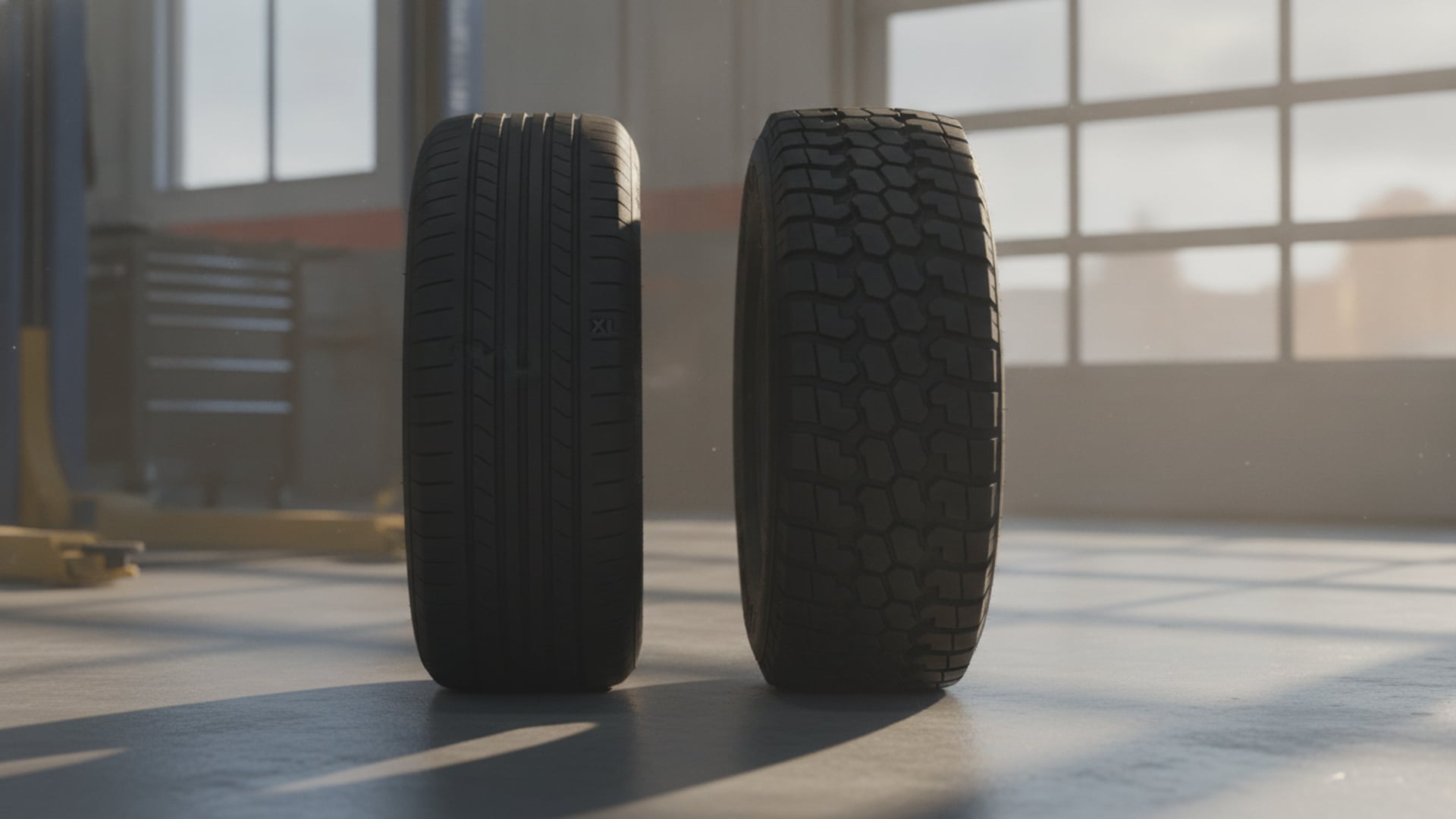
XL and Load Range E aren’t different points on the same scale — they’re two completely different rating systems. XL (Extra Load) is the heavy-duty designation for passenger-car tires (P-metric or Euro-metric), typically rated to about 41 PSI maximum. Load Range E is a Light Truck (LT) tire rating that means 10-ply equivalent construction with an 80 PSI maximum. Same tire size will have very different capacities depending on which designation it carries.
The two are easy to confuse because they’re both “stronger than standard,” but they’re not interchangeable. An XL passenger tire can’t safely substitute for a Load Range E truck tire on a 3/4-ton pickup. An E-rated tire on a sedan will give you a brutally stiff ride for no usable capability gain.
This guide explains what each designation means, the load capacity differences, and how to choose between them.
The Quick Comparison
| XL (Extra Load) | Load Range E | |
|---|---|---|
| Tire type | Passenger (P-metric or Euro-metric) | Light Truck (LT) |
| Max inflation | ~41 PSI | 80 PSI |
| Ply equivalent | Reinforced passenger (often 4-ply equivalent) | 10-ply equivalent |
| Sidewall stiffness | Slightly stiffer than standard passenger | Significantly stiffer than passenger |
| Typical use | Heavy sedans, SUVs, performance cars, EVs (which are heavier) | Trucks, large SUVs, work vans, trailers |
| Sidewall marking | “XL” or “Extra Load” or “Reinforced” | “LT” before the size, “Load Range E” or “LRE” |
What XL Actually Means
XL (Extra Load) tires are passenger tires with reinforced internal structure compared to standard passenger tires of the same size. The European equivalent terms are “Reinforced” or “RF”. They’re designed for heavier passenger vehicles that need more load capacity than a standard tire provides — full-size sedans, SUVs, and increasingly, electric vehicles (which are 15–30% heavier than gas equivalents because of the battery pack).
- Carry more weight per tire than standard passenger tires in the same size.
- Maximum inflation typically ~41 PSI, vs. ~35 PSI for a standard passenger tire.
- Marginal stiffness increase over standard — you might feel a small difference in ride; you might not.
- Same tread compounds and wear characteristics as the non-XL version — XL doesn’t change tread life or grip much.
What Load Range E Actually Means
Load Range E is a Light Truck (LT) tire rating — a completely different category from passenger tires. The “LT” prefix on the tire size indicates a fundamentally different construction with stronger sidewalls, deeper tread, and higher pressure capacity. Load Range E specifically means 10-ply equivalent strength with an 80 PSI max.
- Designed for trucks and trailers carrying significant weight.
- 80 PSI maximum — nearly double an XL passenger tire.
- Sidewall is significantly stiffer, which affects ride harshness.
- Carries 3,000–4,000 lbs per tire, depending on size.
- Tread is often deeper than equivalent passenger tires, giving longer life under heavy loads.
How to Tell Which You Have
Look at the tire size on the sidewall. Examples:
- P225/65R17 — P-metric passenger tire. If it’s heavy-duty, the sidewall will also say “XL” or “Extra Load.”
- 225/65R17 (no letter prefix) — Euro-metric passenger. May be “Reinforced” or “RF.”
- LT225/65R17 — Light Truck tire. Will have a Load Range marking (B through F) somewhere on the sidewall.
The LT prefix is the strongest visual signal. Anything without an LT is a passenger tire, even if it’s reinforced; anything with an LT is a truck tire even if the size matches a common passenger size.
Why You Can’t Cross-Substitute
Using XL Where E Is Specified
If your truck or SUV came with LT tires (Load Range D or E), substituting XL passenger tires usually isn’t safe. The XL tire’s max load is lower, and it can’t be inflated to the high pressures (60–80 PSI) needed for heavy loads. You’ll be operating the tire at or near its limit during normal driving. Towing or hauling on it can cause failure.
Using E Where XL Is Specified
If your car or SUV came with P-metric XL tires, switching to LT Load Range E tires of the same size gives you a brutally harsh ride and no usable benefit. The vehicle’s suspension was tuned for the passenger tire’s compliance. The Load Range E tire’s stiff sidewall transmits every road imperfection into the cabin. You also pay more for tires you don’t need.
When XL Is the Right Choice
- Your vehicle came with XL from the factory. Stay with XL. Don’t downgrade to standard or upgrade to LT.
- Your vehicle is an EV. Almost all EV-specific tires are XL because the battery pack adds significant weight. The OEM spec on a Tesla, Mustang Mach-E, or Polestar will be XL.
- Your vehicle is a heavy sedan or unibody SUV that was designed for reinforced passenger tires (BMW 7-series, Mercedes S-Class, large Volvos, etc.). XL is normal here.
When Load Range E Is the Right Choice
- You drive a 3/4-ton or 1-ton truck (F-250, Silverado 2500, Ram 2500). These came with E or higher from the factory.
- You tow heavily with any truck or SUV designed for LT tires.
- You carry significant cargo in a work truck or commercial vehicle.
- Your travel trailer is rated for Load Range E tires (most large trailers are).
Inflation Pressures Are Different Too
An important point of confusion: the door-jamb spec for an XL tire is much lower than for a Load Range E tire. If you replace XL tires with E (which you generally shouldn’t), don’t just use the same door-jamb pressure — the E tire will be wildly underinflated.
- XL passenger tire on an SUV: typical door-jamb spec is 32–38 PSI.
- Load Range E LT tire on a 3/4-ton truck: typical door-jamb spec is 50–65 PSI for the rear, depending on load.
If you have any doubt about which pressure to use, check your owner’s manual or ask a tire shop to verify based on the actual tires you have mounted.
Bottom Line
XL and Load Range E are not points on the same scale. XL is a passenger-tire reinforced rating (~41 PSI max). Load Range E is a light-truck heavy-duty rating (80 PSI max, 10-ply equivalent). The two serve different vehicle categories and aren’t safely interchangeable.
Match what your vehicle came with from the factory. EVs and heavy sedans use XL. Trucks, large SUVs, and trailers use Load Range D or E. Substituting across categories costs you safety, ride quality, or both.