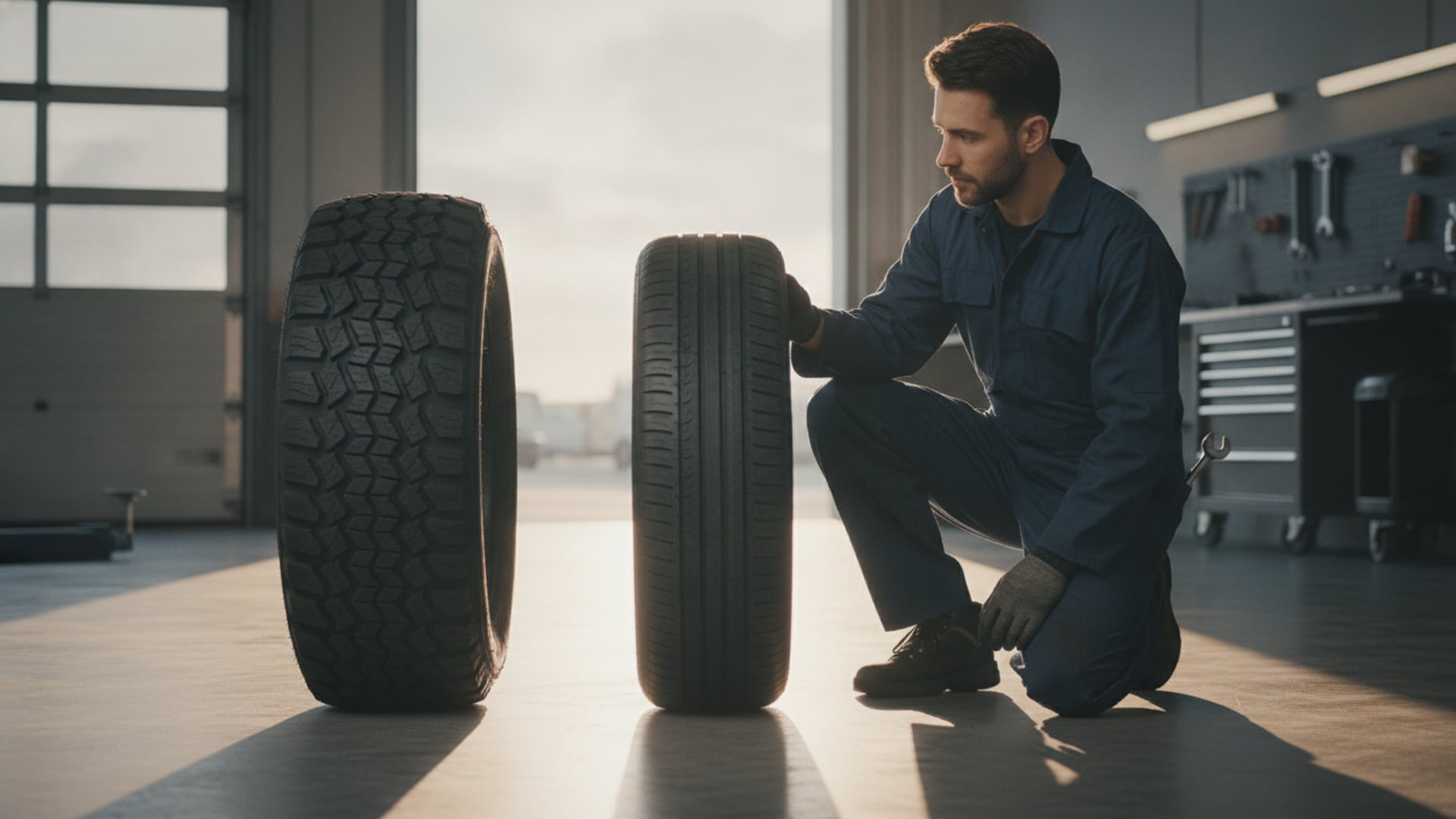
A mechanic comparing two tires of different widths in a service garage

Pros and Cons of Wider Tires


 |  Last Updated:

Jun 24, 2026 @ 9:39 pm

Time To Read:

6 minutes

 |  Last Updated:

Jun 24, 2026 @ 9:39 pm

Time To Read:

6 minutes

Wider tires give you more contact patch with the road, which translates into measurably better dry grip, sharper cornering, and a more planted, aggressive look. They also cost you fuel economy, hurt your wet-weather and snow performance, transmit more road noise into the cabin, can rub on suspension components at full steering lock, and put additional stress on wheel bearings designed for the original tire size.

Whether the trade is worth it depends almost entirely on what you’re trying to accomplish. If you autocross or track-day, wider is usually a net win. If you commute through Seattle rain in a small sedan, wider is a measurable safety downgrade. Most plus-sizing decisions land somewhere in between — you give up a meaningful amount of weather and economy performance for a smaller, mostly-cosmetic improvement in handling.

This guide covers the actual trade-offs at each axis — performance, weather, comfort, fuel economy, fitment, and longevity — so you can decide whether wider is worth it for your situation.

The Pros

Better Dry Traction

More rubber on the road means more friction. A wider tire has a wider contact patch, which gives you better grip during acceleration, braking, and cornering on dry pavement. The effect is measurable on a skidpad and noticeable during spirited driving. For most daily commutes, the improvement is too small to feel.

Sharper Cornering Response

Wider tires generally have stiffer sidewalls (when sized correctly) and a flatter contact patch. The combination gives you faster steering response and more confidence pushing the car through corners. Track-day enthusiasts care about this; commuters mostly don’t notice.

Improved Visual Stance

Wider tires fill out the wheel wells better and give the vehicle a more aggressive look. This is often the actual reason people plus-size, even when the technical improvements are minimal.

Slightly Longer Tread Life (Sometimes)

More tread surface means the wear is spread over a larger area. In equivalent compound and construction, a wider tire can last slightly longer than a narrower one carrying the same load. The effect is small (5–10% in most cases) and easily offset by a softer high-performance compound.

The Cons

Worse Wet-Weather Performance

Wider tires hydroplane more easily. The wider contact patch needs more water to be displaced per unit time to keep the rubber in contact with the road. At any given speed and water depth, a wider tire is closer to its hydroplaning threshold than a narrower tire. This is a measurable safety downgrade for drivers in wet climates.

Worse Snow Performance

Same physics as rain, more pronounced effect. Snow traction depends on the tire cutting through to the pavement underneath; a narrower tire applies more pressure per square inch and cuts through snow more easily. Skinny winter tires were standard on rally cars for decades for this reason. If you drive in snow, wider tires are a meaningful downgrade.

Worse Fuel Economy

Wider tires have more rolling resistance — more rubber flexing against the road takes more energy to keep rolling. Plus the wider tire is heavier, which adds rotational mass that has to be accelerated. Expect a 2–5% drop in fuel economy when going from a stock tire to one 20–30mm wider. Over a year of normal driving, that adds up.

Harsher Ride

Wider tires often pair with shorter sidewalls (the “plus-size” pattern where wheel diameter increases and sidewall height decreases to keep overall diameter the same). Shorter sidewalls have less flex to absorb road imperfections, so every expansion joint, pothole, and rough patch transmits more directly into the cabin.

More Road Noise

More contact patch means more tire-road noise. Performance tires (which are typically what’s available in wider sizes) also tend to have aggressive tread patterns that are noisier by design. Expect noticeable additional cabin noise at highway speeds.

Rubbing Issues

The vehicle’s wheel wells were designed around the original tire size. Going wider can cause the tire to contact:

  • Inner fender liner at full steering lock
  • Suspension components (struts, control arms) during compression
  • Body work if the vehicle is lowered or carries a heavy load

Rubbing isn’t theoretical — it can damage the tire (causing premature failure) or the body. Test-fit before committing, and consider wheel spacers or fender modifications if rubbing occurs.

Wheel Bearing and Suspension Stress

Wider tires create more lateral force at the wheel bearing, especially during cornering. The bearings, hubs, and CV joints were sized for the original tire’s load profile. Going significantly wider can shorten their lifespan, though the effect varies by vehicle. Hard cornering with wide tires is harder on the drivetrain than the same cornering with stock tires.

More Expensive Tires

Wider tires cost more per tire (usually 15–30%), and they may also drop into a category (UHP, summer, etc.) where you have fewer brand options and higher prices than the more common touring sizes.

When Going Wider Is Worth It

  • You autocross or track-day. The grip improvement is real and useful, and the weather/economy downsides don’t apply on the track.
  • You drive a performance car in a dry climate. A Porsche owner in Phoenix gets the cornering benefit without the rain penalty.
  • You’re plus-sizing to fit a specific wheel. Aftermarket wheels often dictate tire width, and a slight increase from stock is usually fine.
  • The vehicle was already designed for wider tires (some trims of the same model come with wider tires from the factory). Switching up to those is a known-safe upgrade.

When Going Wider Is a Bad Trade

  • You drive in a wet climate or snow. The hydroplaning and snow penalties are real safety issues.
  • You commute and care about fuel economy. A 3% fuel hit is small per tank but real over a year.
  • You’re chasing a “look” without other reasons. Wheels and offset can give you most of the visual improvement without changing tire dimensions.
  • The vehicle wasn’t designed for wider tires. Bearings, hubs, fender clearance, and even computer-controlled traction systems can struggle with significant deviations from stock.

The Compromise: Plus-One Sizing

The most common “wider tire” decision is plus-one sizing: a slightly wider tire on a slightly larger wheel, with the sidewall reduced to keep overall rolling diameter the same. Done correctly, this is usually a manageable trade — small grip and looks improvement, small ride and economy penalty, no clearance issues.

Going more than plus-one (plus-two, plus-three) compounds all the downsides. Each step up adds more rubbing risk, more harshness, more economy loss, with diminishing returns on grip.

Bottom Line

Wider tires improve dry traction and cornering at measurable cost to wet weather performance, snow performance, fuel economy, ride quality, road noise, and parts longevity. For most daily drivers, the trade isn’t worth it — you’re sacrificing real performance in conditions you’ll actually encounter (rain, fuel costs) for an improvement you’ll rarely access (track-day cornering grip).

If you do go wider, a plus-one sizing is the safest compromise. Anything more aggressive is enthusiast territory — worth knowing what you’re giving up before committing.

Related Guides

About The Author

Will Creech
Will Creech

Will Creech is the founder of TireGrades.com and has been immersed in the tire industry for over three decades. His expertise was shaped by growing up alongside the founder of Parrish Tire in Charlotte, NC, and later honed through a consulting contract with Discount Tire, where he developed training courses and strategic planning materials.

An active SCCA participant and lifelong automotive enthusiast, Will personally researches, writes, and produces every review on TireGrades — including 300+ companion video reviews on YouTube. His approach combines aggregated real-world owner data with deep industry knowledge to help drivers find the right tire at the right price.

YouTube Icon
LinkedIn icon
YouTube Icon
LinkedIn icon

Wider tires give you more contact patch with the road, which translates into measurably better dry grip, sharper cornering, and a more planted, aggressive look. They also cost you fuel economy, hurt your wet-weather and snow performance, transmit more road noise into the cabin, can rub on suspension components at full steering lock, and put additional stress on wheel bearings designed for the original tire size.

Whether the trade is worth it depends almost entirely on what you’re trying to accomplish. If you autocross or track-day, wider is usually a net win. If you commute through Seattle rain in a small sedan, wider is a measurable safety downgrade. Most plus-sizing decisions land somewhere in between — you give up a meaningful amount of weather and economy performance for a smaller, mostly-cosmetic improvement in handling.

This guide covers the actual trade-offs at each axis — performance, weather, comfort, fuel economy, fitment, and longevity — so you can decide whether wider is worth it for your situation.

The Pros

Better Dry Traction

More rubber on the road means more friction. A wider tire has a wider contact patch, which gives you better grip during acceleration, braking, and cornering on dry pavement. The effect is measurable on a skidpad and noticeable during spirited driving. For most daily commutes, the improvement is too small to feel.

Sharper Cornering Response

Wider tires generally have stiffer sidewalls (when sized correctly) and a flatter contact patch. The combination gives you faster steering response and more confidence pushing the car through corners. Track-day enthusiasts care about this; commuters mostly don’t notice.

Improved Visual Stance

Wider tires fill out the wheel wells better and give the vehicle a more aggressive look. This is often the actual reason people plus-size, even when the technical improvements are minimal.

Slightly Longer Tread Life (Sometimes)

More tread surface means the wear is spread over a larger area. In equivalent compound and construction, a wider tire can last slightly longer than a narrower one carrying the same load. The effect is small (5–10% in most cases) and easily offset by a softer high-performance compound.

The Cons

Worse Wet-Weather Performance

Wider tires hydroplane more easily. The wider contact patch needs more water to be displaced per unit time to keep the rubber in contact with the road. At any given speed and water depth, a wider tire is closer to its hydroplaning threshold than a narrower tire. This is a measurable safety downgrade for drivers in wet climates.

Worse Snow Performance

Same physics as rain, more pronounced effect. Snow traction depends on the tire cutting through to the pavement underneath; a narrower tire applies more pressure per square inch and cuts through snow more easily. Skinny winter tires were standard on rally cars for decades for this reason. If you drive in snow, wider tires are a meaningful downgrade.

Worse Fuel Economy

Wider tires have more rolling resistance — more rubber flexing against the road takes more energy to keep rolling. Plus the wider tire is heavier, which adds rotational mass that has to be accelerated. Expect a 2–5% drop in fuel economy when going from a stock tire to one 20–30mm wider. Over a year of normal driving, that adds up.

Harsher Ride

Wider tires often pair with shorter sidewalls (the “plus-size” pattern where wheel diameter increases and sidewall height decreases to keep overall diameter the same). Shorter sidewalls have less flex to absorb road imperfections, so every expansion joint, pothole, and rough patch transmits more directly into the cabin.

More Road Noise

More contact patch means more tire-road noise. Performance tires (which are typically what’s available in wider sizes) also tend to have aggressive tread patterns that are noisier by design. Expect noticeable additional cabin noise at highway speeds.

Rubbing Issues

The vehicle’s wheel wells were designed around the original tire size. Going wider can cause the tire to contact:

  • Inner fender liner at full steering lock
  • Suspension components (struts, control arms) during compression
  • Body work if the vehicle is lowered or carries a heavy load

Rubbing isn’t theoretical — it can damage the tire (causing premature failure) or the body. Test-fit before committing, and consider wheel spacers or fender modifications if rubbing occurs.

Wheel Bearing and Suspension Stress

Wider tires create more lateral force at the wheel bearing, especially during cornering. The bearings, hubs, and CV joints were sized for the original tire’s load profile. Going significantly wider can shorten their lifespan, though the effect varies by vehicle. Hard cornering with wide tires is harder on the drivetrain than the same cornering with stock tires.

More Expensive Tires

Wider tires cost more per tire (usually 15–30%), and they may also drop into a category (UHP, summer, etc.) where you have fewer brand options and higher prices than the more common touring sizes.

When Going Wider Is Worth It

  • You autocross or track-day. The grip improvement is real and useful, and the weather/economy downsides don’t apply on the track.
  • You drive a performance car in a dry climate. A Porsche owner in Phoenix gets the cornering benefit without the rain penalty.
  • You’re plus-sizing to fit a specific wheel. Aftermarket wheels often dictate tire width, and a slight increase from stock is usually fine.
  • The vehicle was already designed for wider tires (some trims of the same model come with wider tires from the factory). Switching up to those is a known-safe upgrade.

When Going Wider Is a Bad Trade

  • You drive in a wet climate or snow. The hydroplaning and snow penalties are real safety issues.
  • You commute and care about fuel economy. A 3% fuel hit is small per tank but real over a year.
  • You’re chasing a “look” without other reasons. Wheels and offset can give you most of the visual improvement without changing tire dimensions.
  • The vehicle wasn’t designed for wider tires. Bearings, hubs, fender clearance, and even computer-controlled traction systems can struggle with significant deviations from stock.

The Compromise: Plus-One Sizing

The most common “wider tire” decision is plus-one sizing: a slightly wider tire on a slightly larger wheel, with the sidewall reduced to keep overall rolling diameter the same. Done correctly, this is usually a manageable trade — small grip and looks improvement, small ride and economy penalty, no clearance issues.

Going more than plus-one (plus-two, plus-three) compounds all the downsides. Each step up adds more rubbing risk, more harshness, more economy loss, with diminishing returns on grip.

Bottom Line

Wider tires improve dry traction and cornering at measurable cost to wet weather performance, snow performance, fuel economy, ride quality, road noise, and parts longevity. For most daily drivers, the trade isn’t worth it — you’re sacrificing real performance in conditions you’ll actually encounter (rain, fuel costs) for an improvement you’ll rarely access (track-day cornering grip).

If you do go wider, a plus-one sizing is the safest compromise. Anything more aggressive is enthusiast territory — worth knowing what you’re giving up before committing.

Related Guides

About The Author

Will Creech
Will Creech

Will Creech is the founder of TireGrades.com and has been immersed in the tire industry for over three decades. His expertise was shaped by growing up alongside the founder of Parrish Tire in Charlotte, NC, and later honed through a consulting contract with Discount Tire, where he developed training courses and strategic planning materials.

An active SCCA participant and lifelong automotive enthusiast, Will personally researches, writes, and produces every review on TireGrades — including 300+ companion video reviews on YouTube. His approach combines aggregated real-world owner data with deep industry knowledge to help drivers find the right tire at the right price.

YouTube Icon
LinkedIn icon
YouTube Icon
LinkedIn icon