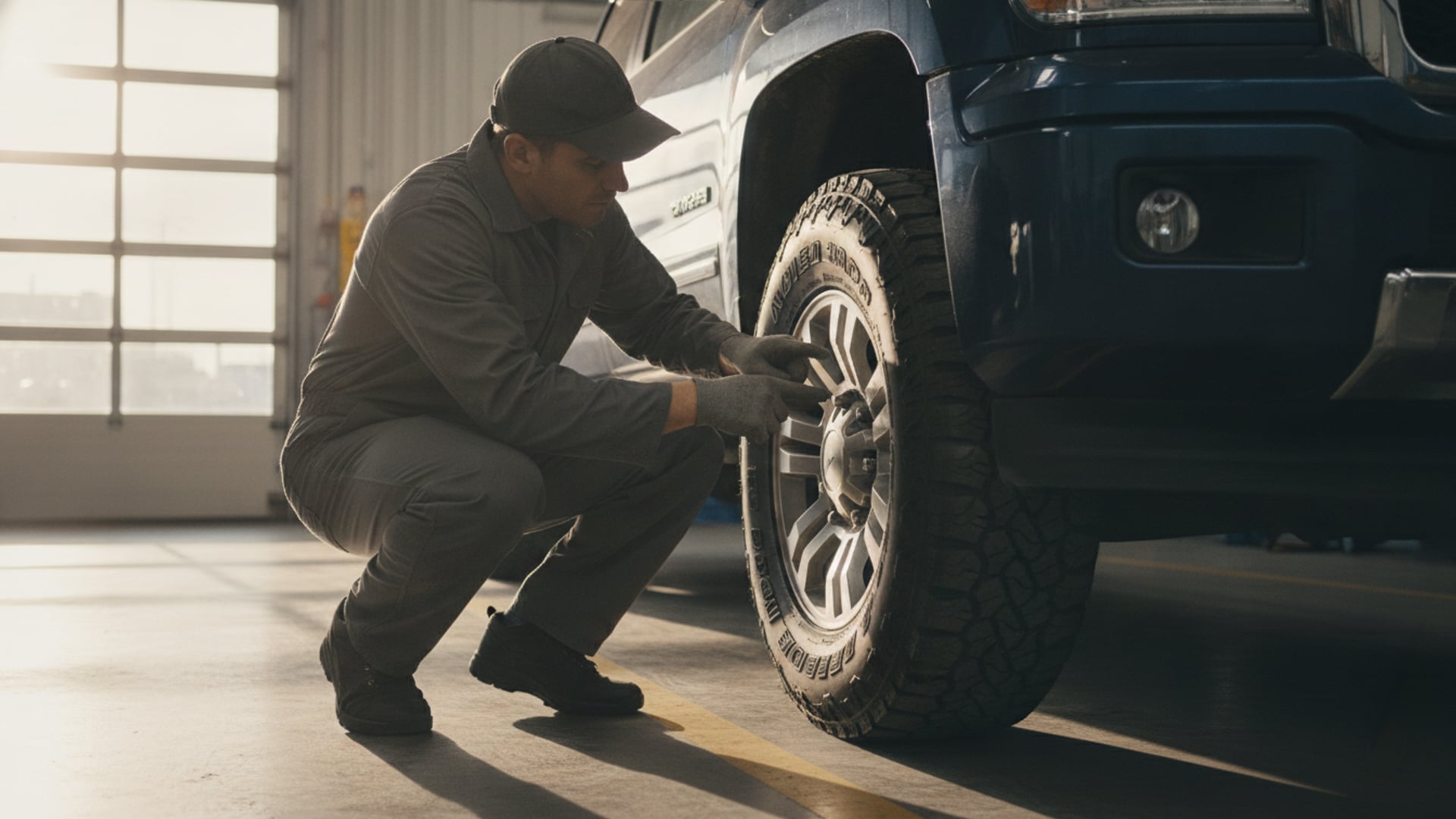
A mechanic examining the sidewall of a heavy-duty tire on a dark blue pickup truck in a service garage

What Is Load Range E on a Tire?


 |  Last Updated:

Jun 24, 2026 @ 9:39 pm

Time To Read:

6 minutes

 |  Last Updated:

Jun 24, 2026 @ 9:39 pm

Time To Read:

6 minutes

Load Range E is a tire rating that indicates the tire is built to 10-ply equivalent strength and can hold a maximum of 80 PSI of air pressure. It’s the most common heavy-duty rating you’ll see on full-size trucks, 3/4-ton and 1-ton pickups, large SUVs, towing tires, and trailer tires. The “E” doesn’t stand for anything specific — it’s a letter grade in a series that runs from A (weakest) to F (strongest).

The practical meaning: Load Range E tires can carry significantly more weight than passenger-rated tires of the same size, at the cost of a stiffer ride and slightly worse handling on a vehicle that doesn’t need the extra capacity. Whether you actually need Load Range E depends on what you’re hauling and what the vehicle was designed for.

This guide explains what Load Range E means in practical terms, when you need it, when Load Range D is enough, and when running E on a half-ton truck is overkill.

The Quick Answer

  • 10-ply equivalent construction. The tire is built with reinforced sidewalls and a higher-strength internal structure than passenger tires.
  • Max inflation: 80 PSI. Recommended operating pressure depends on the load — not necessarily the max. Your vehicle’s door jamb spec is still the authoritative pressure for everyday driving.
  • Typical load capacity: 3,000–4,000 lbs per tire depending on size. Specific number is on the sidewall.
  • Common vehicles: 3/4-ton pickups (F-250, Silverado 2500, Ram 2500), 1-ton pickups (F-350, Silverado 3500), full-size SUVs that tow regularly, work vans, and trailer tires.
  • Identifier on the sidewall: “Load Range E” written out, or “LRE”, or “10PR” (10 ply rating), often near the “LT” (Light Truck) marking.

What “Load Range” Actually Means

Load range is the modern letter-based system for indicating tire construction strength. It replaced the older “ply rating” system that counted actual layers of fabric in the tire. Modern tires use far fewer physical layers than the old plies system — usually 1–3 plies of high-strength material that’s stronger than the old multi-layer cotton or rayon construction. The “equivalent ply” rating is the comparison point: how strong this modern tire is relative to the old plies-of-cotton standard.

Load RangePly Rating EquivalentMax PSITypical Use
B4 ply35 PSIStandard passenger cars, light trailers
C6 ply50 PSILight trucks, small SUVs, mid-size trailers
D8 ply65 PSIHalf-ton trucks, full-size SUVs, larger trailers
E10 ply80 PSI3/4-ton+ trucks, heavy SUVs, large trailers
F12 ply95 PSI1-ton+ commercial use, heavy hauling

When You Actually Need Load Range E

  • You’re driving a 3/4-ton or 1-ton truck. These vehicles were designed around Load Range E or higher. Anything less puts the tires near their max load with normal payload.
  • You tow regularly (over 5,000 lbs trailer weight) with any truck or SUV. The trailer weight transfers significant load through your tow vehicle’s rear tires.
  • You carry heavy loads in the bed or cargo area routinely. Work trucks, RVs, anyone hauling building materials.
  • You drive a vehicle that came with Load Range E from the factory. The manufacturer engineered the suspension, brakes, and chassis around the higher-rated tires; switching down typically isn’t safe.

When Load Range E Is Overkill

  • You drive a half-ton truck (F-150, Silverado 1500, Ram 1500) and don’t tow or carry significant weight. Load Range D is usually adequate, and Load Range E gives you a harsher ride for no real benefit.
  • You bought a vehicle that came with Load Range C or D from the factory. The suspension and ride were tuned for that capacity. Upgrading to E often makes the ride noticeably harsher without adding usable capability.
  • You’re choosing tires for daily commuting in a passenger vehicle. Load Range B or C is standard. Going up the load range scale gains you nothing for typical driving and costs you ride quality, fuel economy, and (slightly) handling.

Trade-offs: What You Get and What You Give Up

Load Range E isn’t strictly “better” than lower load ranges — it’s just more capable at carrying weight. The trade-offs are real:

  • You gain: higher load capacity (3,000–4,000 lbs per tire), stronger sidewall that resists impact damage on rocks or curbs, longer tread life in many cases (heavier tire construction = slower wear), better cornering stability when loaded.
  • You lose: ride quality (stiffer sidewall transmits more road imperfection), fuel economy (heavier tires = more rolling resistance), highway noise (often slightly louder), and acceleration feel (more rotating mass).
  • Pricing: Load Range E tires typically cost 10–25% more than equivalent passenger tires in the same size.

Load Range E vs. Load Range D

The most common decision is E vs. D. Here’s how to choose:

  • Vehicle was designed for E: stay with E. Don’t downgrade.
  • Vehicle was designed for D and you tow occasionally (under 5,000 lbs): D is fine. Upgrading to E mostly adds harshness.
  • Vehicle was designed for D and you tow heavily (5,000+ lbs) or carry significant cargo: consider E for the extra margin. Or stay with D and inflate to spec; D handles most half-ton towing fine.
  • You want a smoother ride and don’t haul: D will be more comfortable than E in most situations.

Pressure Setting for Load Range E

The 80 PSI maximum is exactly that — a maximum. Most Load Range E tires don’t need to run anywhere near that for daily driving. Your driver’s door jamb sticker has the actual recommended pressure for your vehicle and load:

  • Unloaded daily driving: typically 50–65 PSI on a 3/4-ton truck.
  • Heavy load or trailer: typically 65–80 PSI, depending on weight.
  • Empty pickup with no cargo: over-inflating to 80 PSI gives you a brutal ride for no benefit. Run the door-jamb spec.

Bottom Line

Load Range E is the standard heavy-duty rating: 10-ply-equivalent construction, 80 PSI max, used on 3/4-ton+ trucks, full-size SUVs, work vans, and trailers. It carries 3,000–4,000 lbs per tire and is built for towing, heavy cargo, and rough conditions.

If your vehicle came with E from the factory, stay with E. If you have a half-ton truck and don’t tow heavily, Load Range D will give you a better ride at lower cost. If you’re driving a passenger car, you don’t need to think about Load Range E at all — you’d be running B or C.

Related Guides

About The Author

Will Creech
Will Creech

Will Creech is the founder of TireGrades.com and has been immersed in the tire industry for over three decades. His expertise was shaped by growing up alongside the founder of Parrish Tire in Charlotte, NC, and later honed through a consulting contract with Discount Tire, where he developed training courses and strategic planning materials.

An active SCCA participant and lifelong automotive enthusiast, Will personally researches, writes, and produces every review on TireGrades — including 300+ companion video reviews on YouTube. His approach combines aggregated real-world owner data with deep industry knowledge to help drivers find the right tire at the right price.

YouTube Icon
LinkedIn icon
YouTube Icon
LinkedIn icon

Load Range E is a tire rating that indicates the tire is built to 10-ply equivalent strength and can hold a maximum of 80 PSI of air pressure. It’s the most common heavy-duty rating you’ll see on full-size trucks, 3/4-ton and 1-ton pickups, large SUVs, towing tires, and trailer tires. The “E” doesn’t stand for anything specific — it’s a letter grade in a series that runs from A (weakest) to F (strongest).

The practical meaning: Load Range E tires can carry significantly more weight than passenger-rated tires of the same size, at the cost of a stiffer ride and slightly worse handling on a vehicle that doesn’t need the extra capacity. Whether you actually need Load Range E depends on what you’re hauling and what the vehicle was designed for.

This guide explains what Load Range E means in practical terms, when you need it, when Load Range D is enough, and when running E on a half-ton truck is overkill.

The Quick Answer

  • 10-ply equivalent construction. The tire is built with reinforced sidewalls and a higher-strength internal structure than passenger tires.
  • Max inflation: 80 PSI. Recommended operating pressure depends on the load — not necessarily the max. Your vehicle’s door jamb spec is still the authoritative pressure for everyday driving.
  • Typical load capacity: 3,000–4,000 lbs per tire depending on size. Specific number is on the sidewall.
  • Common vehicles: 3/4-ton pickups (F-250, Silverado 2500, Ram 2500), 1-ton pickups (F-350, Silverado 3500), full-size SUVs that tow regularly, work vans, and trailer tires.
  • Identifier on the sidewall: “Load Range E” written out, or “LRE”, or “10PR” (10 ply rating), often near the “LT” (Light Truck) marking.

What “Load Range” Actually Means

Load range is the modern letter-based system for indicating tire construction strength. It replaced the older “ply rating” system that counted actual layers of fabric in the tire. Modern tires use far fewer physical layers than the old plies system — usually 1–3 plies of high-strength material that’s stronger than the old multi-layer cotton or rayon construction. The “equivalent ply” rating is the comparison point: how strong this modern tire is relative to the old plies-of-cotton standard.

Load RangePly Rating EquivalentMax PSITypical Use
B4 ply35 PSIStandard passenger cars, light trailers
C6 ply50 PSILight trucks, small SUVs, mid-size trailers
D8 ply65 PSIHalf-ton trucks, full-size SUVs, larger trailers
E10 ply80 PSI3/4-ton+ trucks, heavy SUVs, large trailers
F12 ply95 PSI1-ton+ commercial use, heavy hauling

When You Actually Need Load Range E

  • You’re driving a 3/4-ton or 1-ton truck. These vehicles were designed around Load Range E or higher. Anything less puts the tires near their max load with normal payload.
  • You tow regularly (over 5,000 lbs trailer weight) with any truck or SUV. The trailer weight transfers significant load through your tow vehicle’s rear tires.
  • You carry heavy loads in the bed or cargo area routinely. Work trucks, RVs, anyone hauling building materials.
  • You drive a vehicle that came with Load Range E from the factory. The manufacturer engineered the suspension, brakes, and chassis around the higher-rated tires; switching down typically isn’t safe.

When Load Range E Is Overkill

  • You drive a half-ton truck (F-150, Silverado 1500, Ram 1500) and don’t tow or carry significant weight. Load Range D is usually adequate, and Load Range E gives you a harsher ride for no real benefit.
  • You bought a vehicle that came with Load Range C or D from the factory. The suspension and ride were tuned for that capacity. Upgrading to E often makes the ride noticeably harsher without adding usable capability.
  • You’re choosing tires for daily commuting in a passenger vehicle. Load Range B or C is standard. Going up the load range scale gains you nothing for typical driving and costs you ride quality, fuel economy, and (slightly) handling.

Trade-offs: What You Get and What You Give Up

Load Range E isn’t strictly “better” than lower load ranges — it’s just more capable at carrying weight. The trade-offs are real:

  • You gain: higher load capacity (3,000–4,000 lbs per tire), stronger sidewall that resists impact damage on rocks or curbs, longer tread life in many cases (heavier tire construction = slower wear), better cornering stability when loaded.
  • You lose: ride quality (stiffer sidewall transmits more road imperfection), fuel economy (heavier tires = more rolling resistance), highway noise (often slightly louder), and acceleration feel (more rotating mass).
  • Pricing: Load Range E tires typically cost 10–25% more than equivalent passenger tires in the same size.

Load Range E vs. Load Range D

The most common decision is E vs. D. Here’s how to choose:

  • Vehicle was designed for E: stay with E. Don’t downgrade.
  • Vehicle was designed for D and you tow occasionally (under 5,000 lbs): D is fine. Upgrading to E mostly adds harshness.
  • Vehicle was designed for D and you tow heavily (5,000+ lbs) or carry significant cargo: consider E for the extra margin. Or stay with D and inflate to spec; D handles most half-ton towing fine.
  • You want a smoother ride and don’t haul: D will be more comfortable than E in most situations.

Pressure Setting for Load Range E

The 80 PSI maximum is exactly that — a maximum. Most Load Range E tires don’t need to run anywhere near that for daily driving. Your driver’s door jamb sticker has the actual recommended pressure for your vehicle and load:

  • Unloaded daily driving: typically 50–65 PSI on a 3/4-ton truck.
  • Heavy load or trailer: typically 65–80 PSI, depending on weight.
  • Empty pickup with no cargo: over-inflating to 80 PSI gives you a brutal ride for no benefit. Run the door-jamb spec.

Bottom Line

Load Range E is the standard heavy-duty rating: 10-ply-equivalent construction, 80 PSI max, used on 3/4-ton+ trucks, full-size SUVs, work vans, and trailers. It carries 3,000–4,000 lbs per tire and is built for towing, heavy cargo, and rough conditions.

If your vehicle came with E from the factory, stay with E. If you have a half-ton truck and don’t tow heavily, Load Range D will give you a better ride at lower cost. If you’re driving a passenger car, you don’t need to think about Load Range E at all — you’d be running B or C.

Related Guides

About The Author

Will Creech
Will Creech

Will Creech is the founder of TireGrades.com and has been immersed in the tire industry for over three decades. His expertise was shaped by growing up alongside the founder of Parrish Tire in Charlotte, NC, and later honed through a consulting contract with Discount Tire, where he developed training courses and strategic planning materials.

An active SCCA participant and lifelong automotive enthusiast, Will personally researches, writes, and produces every review on TireGrades — including 300+ companion video reviews on YouTube. His approach combines aggregated real-world owner data with deep industry knowledge to help drivers find the right tire at the right price.

YouTube Icon
LinkedIn icon
YouTube Icon
LinkedIn icon