

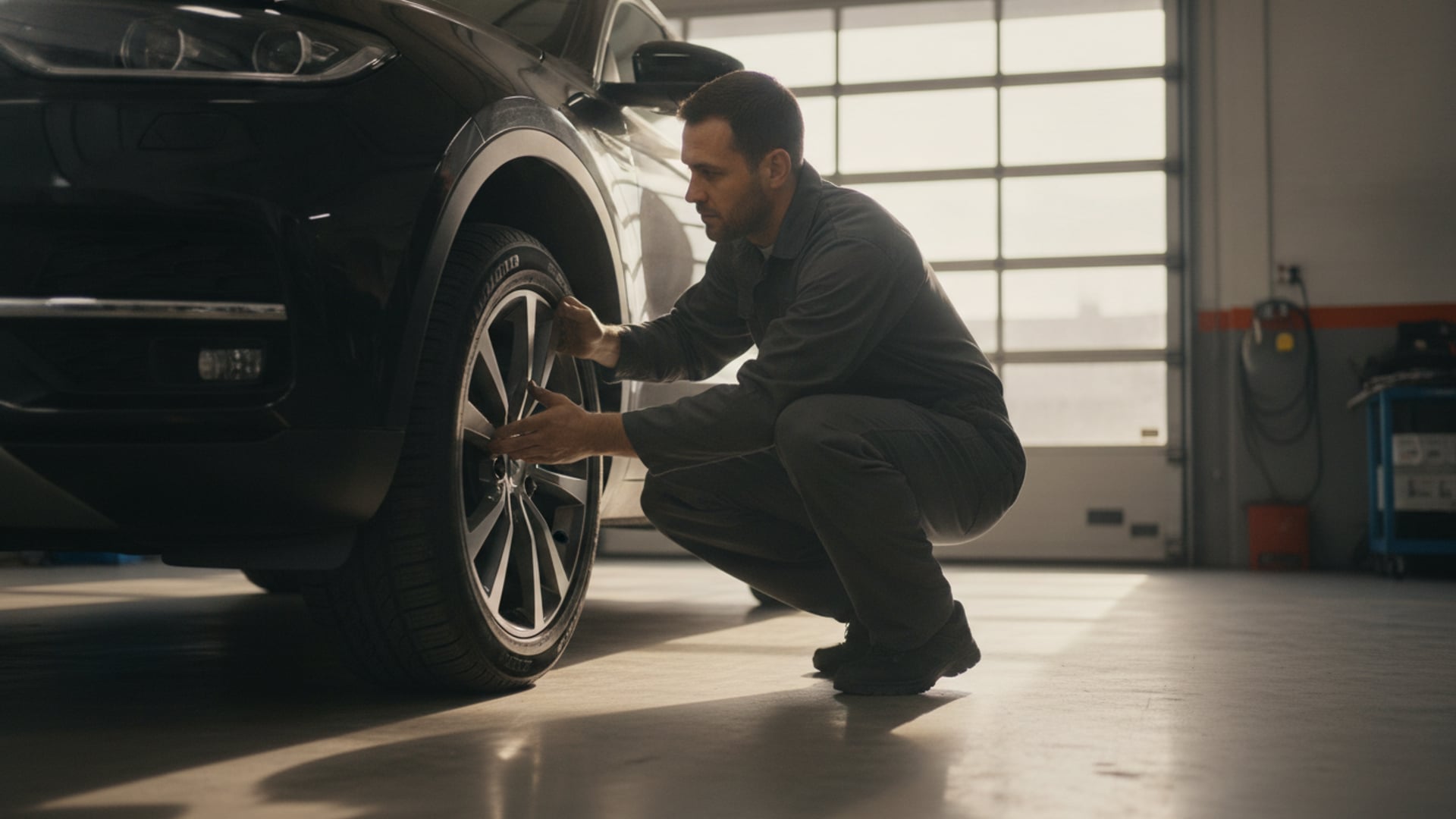
If the inside edge of your tire is wearing faster than the rest of the tread, you have a mechanical problem somewhere underneath your car. Inner tire wear almost never has a benign cause. It’s the visible signature of either misalignment (too much negative camber, almost always) or worn suspension components that are letting the wheel sit at an angle it shouldn’t.
The bad news: by the time you can see the wear pattern clearly, you’ve usually lost months of tire life. The good news: the underlying causes are fixable, and once they’re fixed the wear stops immediately.
This guide explains what causes inner wear, how to figure out which cause is yours, what the fix typically costs, and whether the worn tires can be saved.
The Quick Answer
- Inner wear on one tire only: usually a bent or worn suspension component on that corner (control arm, ball joint, strut) — or a pothole strike that knocked alignment out on just that wheel.
- Inner wear on both front tires: almost always negative camber from alignment drift. Common after suspension work, lowered vehicles, or just normal wear over time.
- Inner wear on both rear tires (independent suspension): same root cause as the front version — negative camber, usually from sagging springs or worn bushings.
- Inner wear with vibration or pulling: something is broken, not just out of alignment. Have it inspected immediately.
Why Inner Wear Specifically Happens
Three alignment angles control how a tire sits and steers: camber, toe, and caster. Camber is the one that wears out the inside edge.
Camber is the tilt of the wheel when viewed from the front of the car. A wheel that’s perfectly vertical has zero camber. A wheel whose top leans inward toward the engine has negative camber. A wheel whose top leans outward has positive camber.
When camber is negative, the inside edge of the tire takes more of the vehicle’s weight than the outside edge. The contact patch isn’t a rectangle anymore — it’s a wedge that’s deeper on the inside. The inside of the tread runs hotter, gets pressed against the road harder, and wears proportionally faster. Over a few thousand miles, that asymmetric wear becomes visible.
Most modern cars are designed with a small amount of negative camber on purpose — usually 0.5° to 1.0° — because it improves cornering grip. The wear from that intentional amount is minimal. The trouble starts when camber drifts beyond spec, to 1.5°, 2°, or more.
The Most Common Causes
1. Alignment Drift (Most Common)
Camber goes out of spec gradually over thousands of miles. Pothole strikes, curb hits, and normal suspension wear all push the wheel slightly out of its factory position. Most cars need an alignment every 1–2 years or after any significant suspension impact. If you’ve never had an alignment done, or it’s been more than two years, this is probably the cause.
Fix: A four-wheel alignment, typically $80–$150 at a tire shop or dealer. On most cars camber can be adjusted with shims or eccentric bolts. On a few cars (some Hondas, some VWs) factory camber isn’t adjustable without aftermarket camber kits ($100–$300 added to the alignment).
2. Worn Control Arm Bushings
Control arms connect the wheel hub to the frame. Their bushings (rubber or polyurethane joints) absorb suspension movement. When bushings wear out, the wheel can shift position under load — effectively giving you negative camber even though the alignment “reads” correct on a static rack.
Diagnosis: A mechanic can check by jacking up the wheel and pushing/pulling on it. Excessive play points to bushings or ball joints. Some bushings are inspectable visually if cracking or oil seeping out.
Fix: $200–$600 per side depending on whether the bushings can be pressed in/out of the existing arms or the whole control arm needs replacement.
3. Worn Ball Joints
Ball joints are the pivot points where the control arm meets the steering knuckle. As they wear, the wheel develops play and changes its resting angle under load. Worn ball joints often produce a clunking sound over bumps as well as visible inner tire wear.
Fix: $150–$400 per side. Don’t put off ball joint replacement — a failed ball joint can let a wheel separate from the car.
4. Sagging Springs or Worn Struts
Coil springs and strut assemblies lose stiffness over time. As the vehicle sits lower than its design height, the suspension geometry changes — usually pulling the top of the wheel inward and adding negative camber. This effect is especially common after 100,000 miles or in vehicles that have been carrying heavy loads.
Fix: $400–$1,200 per axle depending on whether you replace springs only or full strut assemblies. Often paired with an alignment after the work is done.
5. Lowered Vehicles Without Camber Correction
Lowering springs or coilovers without adjusting camber will produce inner wear almost immediately. The lower the vehicle, the more negative camber you induce by default. This is a known trade-off — if you’ve lowered the car and haven’t installed camber kits, this is your cause.
Fix: Aftermarket adjustable camber arms or camber bolts plus a fresh alignment. $300–$800 in parts and labor depending on the specific kit.
How to Diagnose Your Specific Cause
Before you spend money, narrow down the likely cause yourself:
- Pattern check. Is it just one side or both? Both fronts? Just one front? Just one rear? One-sided wear points to suspension damage on that specific corner. Symmetric wear points to alignment.
- Recent events. Have you hit a curb or pothole hard recently? Had any suspension work done? Replaced springs or struts? Any of these can throw alignment out enough to cause measurable inner wear within months.
- Listen. Clunking over bumps suggests ball joints or sway bar end links. A loose steering feel suggests bushings or worn tie rods. Vibration suggests bent wheel or balance — not usually a wear cause but worth ruling out.
- Visual check. With the wheel turned hard, you can see the upper control arm and strut from outside. Look for torn boots, cracked bushings, or visible oil leaks from struts. Any of these means the part is failing.
- Get an alignment check. $20–$40 at most shops just for the measurement. The printout shows you exact camber, toe, and caster numbers vs. factory spec. If camber is way out of spec but other components check out, alignment alone may fix it.
Can the Worn Tire Be Saved?
Usually not. By the time inner wear is visually obvious, the inside of the tread is typically 2–3/32″ thinner than the rest of the tire. That asymmetry doesn’t even out — rotation can’t move it to a part of the tire that wears differently, because the tire’s inside edge is always its inside edge.
There are three possible paths:
- If the inside edge is at or below 4/32″ (most cases): replace the tires. Driving on tires worn this thin on one edge means your wet-weather stopping distance is much longer than normal, plus you’re risking sidewall damage if the wear has reached the wear bars on the inside.
- If you caught it early and the inside is still above 6/32″: fix the cause, then rotate the tires. The wear stops once the cause is fixed, and the remaining life should be enough to justify keeping them.
- If you’ve been ignoring it for a while and cords or fabric are visible on the inside edge: the tire is structurally compromised. Replace today — don’t drive it to the shop, get it replaced at the shop where you noticed it.
One important note: don’t replace tires before fixing the underlying cause. New tires installed on a misaligned or worn suspension will wear the same way. You’ll be back at the tire shop in six months instead of three years.
Bottom Line
Inner tire wear is a symptom, not a cause. The wear itself is the visible effect of negative camber that’s gotten worse than the factory spec — from alignment drift, worn suspension parts, sagging springs, or aftermarket lowering. The fix order is always the same: diagnose the cause, fix the cause, replace the tires only if they’re worn past the safety threshold.
Start with an alignment check. It’s the cheapest diagnostic ($20–$40), it tells you whether you can fix the problem for $150 or whether you have a $600–$1,200 suspension repair on your hands, and the printout tells the next mechanic exactly what’s wrong if you need a second opinion.