

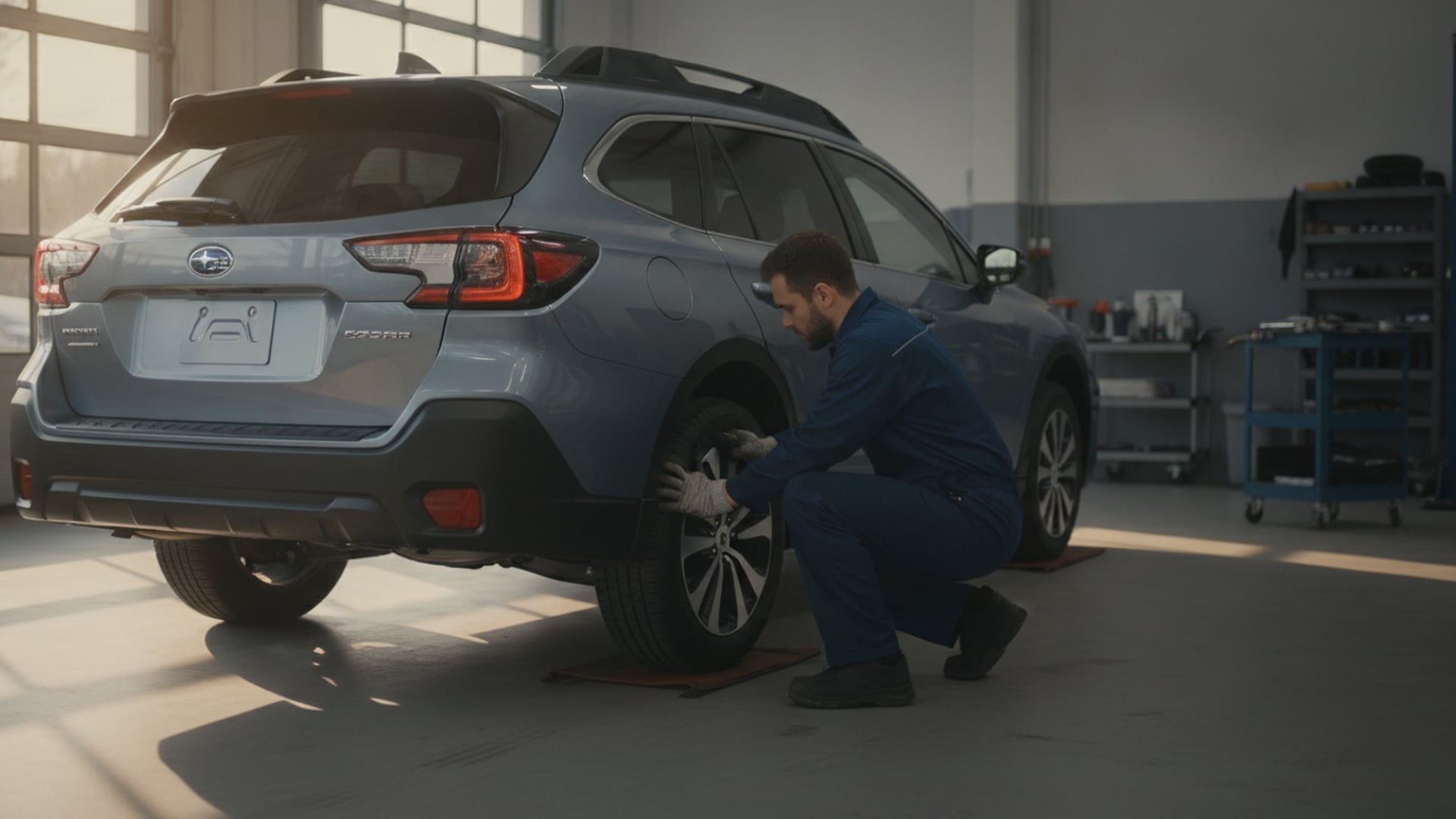
You replace one tire on your AWD car. The shop tells you that you really need to buy four. Your other three still have 6/32″ of tread left. Is that an upsell, or is it actually true?
The short answer: it depends on how worn the others are. AWD vehicles are more sensitive to tire diameter mismatches than front- or rear-wheel-drive cars, but the “always replace all four” rule is a generalization that gets applied way too broadly. In many cases you can replace one or two. In some cases you really do need all four. The line between them is the tread depth difference between your old tires and the new one.
This guide covers what the actual manufacturer tolerances are, when you can safely replace just one or two, when you really can’t, and what happens to your drivetrain if you ignore the limits.
The Quick Answer
Use this as a starting point, then check your owner’s manual for the specific spec for your vehicle.
- Existing tires within 2/32″ of new tread depth (around 8/32″–9/32″ remaining) — you can usually replace just the damaged tire. Most AWD systems tolerate this small a difference.
- Existing tires at 4/32″–7/32″ — you should replace in pairs (both on the same axle) at minimum, and shave the new tires to match if your vehicle is strict about diameter tolerance.
- Existing tires at or below 4/32″ — replace all four. The mismatch is too large to safely operate the AWD system, and the older tires are near replacement anyway.
- Driving a Subaru — assume the strictest case. Subaru’s tolerance is the tightest in the industry. When in doubt, replace all four or shave new tires to match.
Why AWD Cars Are Different
A front- or rear-wheel-drive car only sends power to two wheels. Differences in tire diameter between the driven and non-driven axle don’t matter much, because the non-driven wheels just freewheel and spin at whatever speed the road dictates.
An AWD system sends power to all four wheels. That means every wheel has to rotate at a speed the drivetrain expects, and the differentials and transfer case have to compensate for any difference between them. They’re designed to handle the small, momentary differences that happen when you turn a corner — but not the constant, continuous difference that mismatched tires create.
What “Wheel Speed Differential” Actually Means
A new tire has a larger diameter than a worn one. A larger-diameter tire travels farther per revolution, so it has to rotate fewer times to cover the same distance. If you mix a new tire with three worn tires, the new tire wants to spin slower than the worn ones — but the drivetrain is forcing them all to spin in a fixed ratio.
That mismatch shows up as continuous rotational stress on the differentials, viscous couplings, and (on some systems) the transfer case. A few minutes of stress is fine. Months of daily driving with mismatched tires can grind through clutches, overheat fluid, and cause expensive driveline damage long before the tires themselves wear out.
The Tread Depth Threshold
How much difference is too much depends on the AWD system. Here are the most commonly cited tolerances:
| Manufacturer / System | Tolerance | Notes |
|---|---|---|
| Subaru | About 1/4″ of rolling circumference difference (roughly 2/32″ tread depth) | Strictest in the industry. Damages center differential or viscous coupling if exceeded. |
| Audi quattro | ~4/32″ tread depth difference | Manuals specify circumference; tread depth is the practical proxy. |
| BMW xDrive | ~4/32″ tread depth difference | Newer models with electronically-controlled clutches are slightly more forgiving. |
| Volkswagen 4Motion | ~4/32″ tread depth difference | Same Haldex-based system as some Audi quattro models. |
| Most other AWD (Toyota, Honda, Ford, Mazda, etc.) | 2/32″–4/32″ tread depth difference | Check your owner’s manual. Modern systems with active torque vectoring tend to be more forgiving than older mechanical systems. |
These are conservative starting points. Your owner’s manual is the authoritative source. If you can’t find a spec, assume 2/32″ to stay safe.
Why Subaru Is The Strictest
Subaru’s symmetrical full-time AWD uses a viscous coupling center differential on most CVT models and a mechanical center differential on manual transmissions. Both designs distribute torque continuously rather than reacting to slip after the fact. That gives Subaru excellent traction in mixed conditions, but it also means the system has zero tolerance for continuous wheel-speed differences. Run a mismatched set for a few months and you can cook the viscous coupling — a $1,500–$3,000 repair on its own.
If you drive a Subaru, the practical advice is: replace all four when one fails, or shave the new tire to match. Don’t gamble.
When You Can Get Away With Two (or One)
Scenario A: Your Other Tires Are Nearly New
If your three remaining tires are within 2/32″ of new tread (8/32″–9/32″ remaining on a tire that started life at 10/32″–11/32″), the diameter difference between them and a brand new tire is small enough for most AWD systems to handle. In this case, replacing just the damaged tire is usually fine.
This is the situation where the tire shop’s “you need four” advice is the most aggressive upsell. If you’ve only put a few thousand miles on the original set, one new tire is almost certainly safe.
Scenario B: Tire Shaving
Tire shaving is a service that mechanically removes tread from a new tire to match the depth of your existing tires. A specialty shop will use a tire shaver lathe to bring a 10/32″ new tire down to, say, 6/32″ so it matches your existing set.
- Cost: typically $25–$50 per tire on top of the tire price.
- Availability: not every shop offers it. TireRack offers shaving on tires purchased through them. Some independent tire shops have a shaver on-site; many don’t.
- Trade-off: you’re paying for less tire life. A new tire shaved down to 6/32″ has roughly 4/32″ of usable tread instead of 8/32″. You’re essentially buying a partially-used tire to protect your drivetrain.
- When it makes sense: your existing tires have a lot of life left (6/32″+) and replacing all four would cost significantly more than shaving one or two new ones.
When You Really Do Need All Four
There are three situations where replacing all four is the only sensible choice:
- Your remaining tires are at 4/32″ or below. They’re going to need replacement within the next few thousand miles anyway. Buying one or two new tires now means you’ll be back at the shop for the other two soon, and you’ll have spent more in total on mounting and balancing.
- Your existing tires have substantially uneven wear between them. If one tire is at 7/32″ and another is at 3/32″, you have an alignment, rotation, or mechanical issue that’s wearing tires unevenly. Replacing one tire won’t fix that — and the new tire will just wear unevenly too.
- You drive a Subaru and your tires are anything but nearly new. The tolerance is so tight that even a small mismatch can cause expensive driveline damage over time. The math almost always favors four new tires over a $2,500 viscous coupling replacement.
What Happens If You Ignore the Tolerance
Driving mismatched tires on an AWD system doesn’t fail immediately. The damage is cumulative, builds up over thousands of miles, and usually shows up in one of these failure modes:
- Viscous coupling failure (Subaru and some older systems) — the fluid inside the coupling overheats and breaks down. Symptoms include binding when turning, vibration, and eventually loss of AWD function. Repair cost: $1,500–$3,000.
- Transfer case damage — internal clutches wear out faster than they should. Symptoms include grinding noises, vibration, and warning lights. Repair cost: $1,500–$4,000.
- Differential overheating — center differentials run hotter than designed, breaking down the gear oil and accelerating wear on internal gears and bearings. Repair cost: $1,000–$2,500.
- Drivetrain bind during low-speed turns — a noticeable shuddering or hopping sensation when turning at parking-lot speeds. This is your drivetrain telling you the wheel-speed mismatch is too large. Catching this symptom early can save you from the more expensive failures above.
In every case, the cost of the repair dwarfs the savings from skipping the additional tires. That’s why the “always replace all four” advice exists — it’s an oversimplification, but it’s a safer oversimplification than guessing.
Replacing in Pairs (Front or Rear)
If you’re not replacing all four, you should at least replace in pairs — both fronts together or both rears together. This keeps the tires on each axle matched, which protects the open differential on that axle and keeps handling balanced.
When you do this, put the new pair on the rear axle, even on a front-wheel-drive-biased AWD car. New tires on the rear give you more predictable handling in wet conditions because the rear is less likely to lose grip first. This is the standard tire-industry recommendation regardless of which axle is doing more of the driving work.
A Note on Run-Flat Tires
If your AWD vehicle came with run-flat tires (most BMW xDrive models, some Mini, some Mercedes), the rules are the same — but your replacement options are narrower. Run-flat sidewalls behave differently than standard tires, so you generally can’t mix run-flats with standard tires on the same vehicle. If you’re replacing one, you’re typically replacing with another run-flat of the same construction.
Bottom Line
AWD does not require four new tires every single time. It requires tires that stay within your manufacturer’s diameter tolerance. The “always replace four” advice is a conservative simplification — sometimes it’s correct, sometimes it’s overkill, and the difference is usually visible if you check your remaining tread depth before walking into the tire shop.
If your existing tires have 8/32″ or more of tread, one or two new tires is usually fine. If they’re at 4/32″ or below, four is the right answer. Everything in between depends on your specific AWD system — and the only authoritative source is your owner’s manual.