
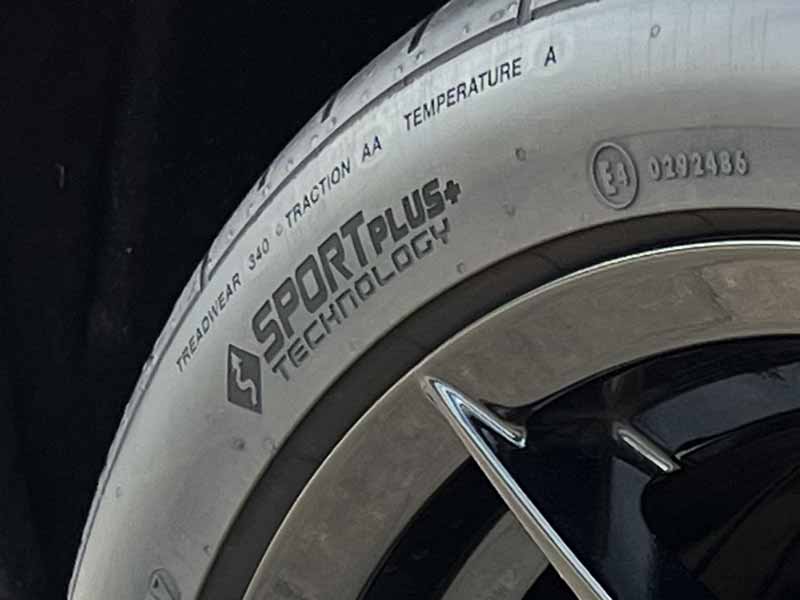
what is utqg

UTQG Ratings Explained


 |  Last Updated:

Mar 9, 2026 @ 4:11 pm

Time To Read:

8 minutes

 |  Last Updated:

Mar 9, 2026 @ 4:11 pm

Time To Read:

8 minutes
YouTube video

Most tires sold in the United States has three grades stamped on its sidewall: a treadwear number, a traction letter, and a temperature letter. These are UTQG ratings — the Uniform Tire Quality Grading system required by the Department of Transportation. They exist to give consumers a standardized way to compare tires.

In theory, UTQG should be the ultimate tire comparison tool. In practice, it’s useful but limited — and knowing where it helps and where it misleads is essential to using it correctly.

Every tire review on TireGrades includes UTQG data alongside our real-world performance scores, so you can compare both the government-mandated ratings and the actual owner experience.
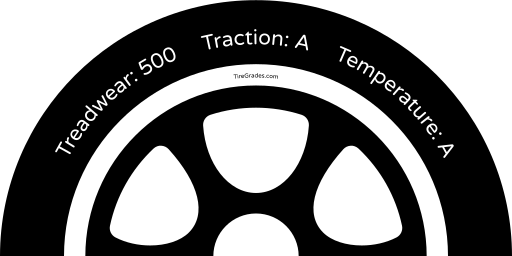
UTQG on Sidewall
UTQG Sidewall Illustration

Treadwear Rating

The treadwear number is the most-referenced UTQG grade and also the most misunderstood.

How It Works

The treadwear rating is a comparative number based on a standardized 7,200-mile test course in Uvalde, Texas. The test tire is run alongside a reference tire (rated at 100), and the treadwear number indicates how the test tire performed relative to that reference.

A tire rated 400 lasted four times as long as the reference tire on the test course. A tire rated 200 lasted twice as long. A tire rated 600 lasted six times as long.
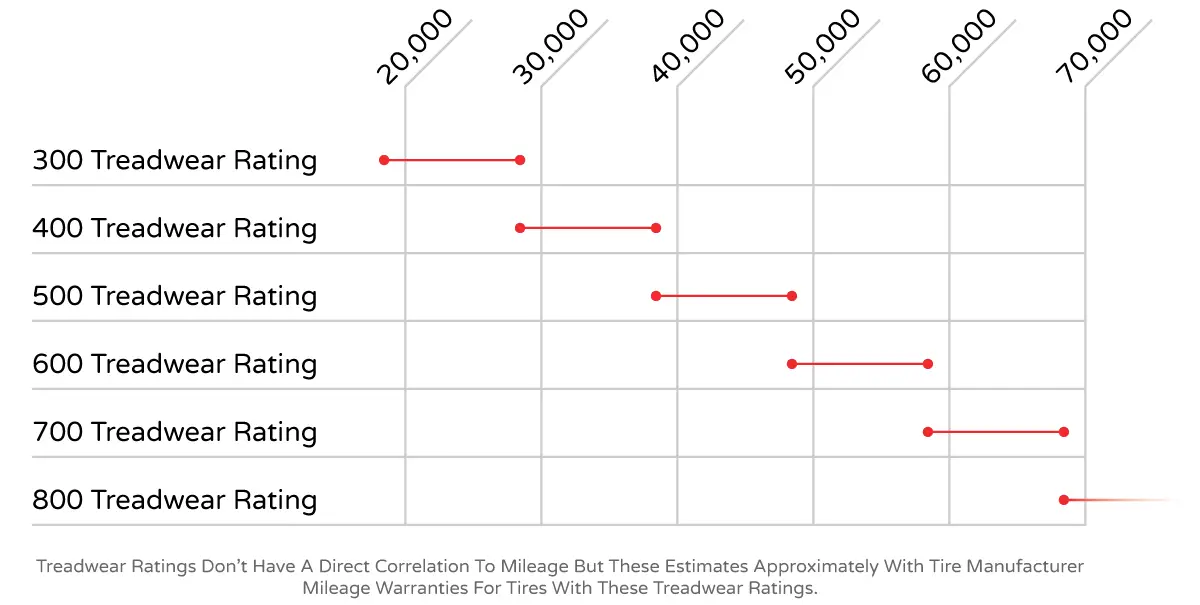
treadwear rating chart
Rough Estimates Of Mileage Potential Based On UTQG Traction Ratings

What’s a Good Treadwear Rating?

Here’s a general framework:

  • 200-300: High-performance and summer tires. These use softer compounds for maximum grip, which wears faster. Don’t expect long tread life — you’re paying for performance, not mileage.
  • 400-500: Balanced performance. Many UHP all-season and sporty touring tires fall here. Decent tread life with good performance characteristics.
  • 500-700: The sweet spot for most drivers. Grand Touring and Standard Touring all-season tires typically land in this range, offering a good balance of performance and longevity.
  • 700-800+: Long-life focused tires. These prioritize tread life above all else, sometimes at the expense of wet grip or handling sharpness.

Why Treadwear Ratings Are Flawed

Here’s the part most sites won’t tell you: treadwear ratings are self-reported by manufacturers. The DOT requires the testing protocol, but each manufacturer conducts their own tests and assigns their own numbers. There’s no independent verification, and different manufacturers calibrate differently.

This means a treadwear rating of 500 from Michelin and a treadwear rating of 500 from a budget brand don’t necessarily indicate the same real-world tread life. Treadwear ratings are most useful for comparing tires within the same brand and least useful for comparing across brands.

For comparing tires across brands, real-world owner feedback on tread life (which is what we use in our Tire Grade scoring) is a much more reliable indicator than UTQG treadwear numbers alone.

Traction Rating

The traction grade measures a tire’s ability to stop on wet pavement in a straight line. It does not measure cornering grip, dry traction, or snow/ice traction — only straight-line wet braking.

The Grades

  • AA — Best. The tire stopped in the shortest distance on wet pavement during testing. Most modern touring and performance tires earn AA.
  • A — Good. Strong wet stopping performance. Perfectly adequate for everyday driving. Many standard and budget tires earn A.
  • B — Acceptable. Meets minimum standards but has noticeably longer wet stopping distances. Less common on modern passenger tires — if you see a B rating, investigate further.
  • C — Marginal. Barely meets standards. Very rare on passenger tires. If you see a C rating, look for alternatives.
Traction GradeWet AsphaltWet Concrete
AAMore Than 0.54 GMore Than 0.38 G
AMore Than 0.47 GMore Than 0.35 G
BMore Than 0.38 GMore Than 0.26 G
CLess Than 0.38 GLess Than 0.26 G

What’s a Good Traction Rating?

For most drivers, A or AA is what you want. The difference between A and AA is measurable but not dramatic in everyday driving. The difference between A and B, however, is significant enough to be a safety concern in heavy rain.

The Limitation

Traction testing only evaluates wet braking on a specific test surface. It tells you nothing about how the tire handles in corners, in snow, at highway speeds, or on different road surfaces. A tire with a AA traction rating can still have mediocre wet cornering grip or poor hydroplaning resistance. Our review scores capture these broader wet-performance dimensions through real owner feedback.

Temperature Rating

The temperature grade indicates the tire’s ability to dissipate heat at sustained high speeds. Heat is the enemy of tire longevity and safety — excessive heat buildup can lead to tread separation and blowouts.

The Grades

  • A — Best. The tire handles heat effectively at speeds above 115 mph during laboratory testing. Most touring and performance tires earn A.
  • B — Good. Handles heat at speeds between 100-115 mph. Common on standard and budget tires.
  • C — Minimum. Handles heat at speeds between 85-100 mph. This is the minimum required to be sold in the US.
Temperature GradesSafe Sustainable Speed
AAbove 115 mph
BBetween 115 mph and 100 mph
CBetween 100 mph and 85 mph

What’s a Good Temperature Rating?

A is preferred. For normal driving, even a B rating is more than adequate since most drivers never sustain speeds above 100 mph. However, if you regularly drive on highways in hot climates (the Southeast, Southwest), an A rating provides a better safety margin since ambient heat adds to the heat generated by driving.

The practical difference between A and B matters more for trucks and SUVs carrying heavy loads at highway speeds, where the combination of weight, speed, and ambient heat pushes tire temperatures higher.

How to Use UTQG When Shopping for Tires

UTQG ratings are best used as a secondary comparison tool, not your primary decision-making factor. Here’s how to use them effectively:

Use treadwear to compare within a brand

If you’re choosing between two Michelin tires, the treadwear numbers give you a reasonable idea of relative longevity. Across brands, take treadwear numbers with a grain of salt.

Use traction as a minimum threshold

Look for A or AA. If a tire has a B traction rating, that’s a yellow flag worth investigating — check whether its real-world wet performance scores back up the lower rating or if it’s an artifact of the testing methodology.

Use temperature as a safety check

A is preferred, B is fine for most driving. C is a concern if you do a lot of highway driving in hot weather.

Always supplement with real-world data

UTQG tells you how a tire performed on a specific test course under controlled conditions. Real-world owner feedback — across thousands of miles, in varying weather, on different vehicles — tells you how it actually performs in the conditions you’ll drive in.

Every tire review on TireGrades includes both UTQG data and our aggregated owner performance scores, so you can see both the standardized grades and the real-world picture.

Where to Find UTQG Ratings

UTQG ratings are required by law to be molded into the sidewall of every passenger tire sold in the US. Look for three lines of text on the sidewall:

  • TREADWEAR [number] — e.g., TREADWEAR 600
  • TRACTION [letter] — e.g., TRACTION A
  • TEMPERATURE [letter] — e.g., TEMPERATURE A

You can also find UTQG ratings on the manufacturer’s website, on retailer product pages, and in every TireGrades review.

Note: UTQG ratings are not required for winter tires or LT (Light Truck) tires, so you may not find them on all tires. When UTQG data is available, we include it in our reviews.

Frequently Asked Questions

Q: What does UTQG 600 AB mean?
A: Treadwear 600 (lasts roughly 6x longer than the reference tire), Traction A (good wet braking), Temperature B (good heat resistance). This is a solid, middle-of-the-road rating common on standard all-season tires.

Q: Are UTQG ratings reliable?
A: They’re standardized but self-reported. The testing methodology is consistent, but manufacturers conduct their own tests. Treadwear is the least reliable across brands because there’s no independent verification. Traction and temperature grades are more straightforward since they have defined pass/fail thresholds.

Q: Why do some tires not have UTQG ratings?
A: UTQG is only required for passenger tires sold in the US. Winter tires, LT tires, trailer tires, and tires sold outside the US may not carry UTQG grades.

Q: Is a higher treadwear rating always better?
A: Not necessarily. Higher treadwear usually comes at the expense of wet grip and handling performance. The softer compounds that deliver the best traction wear faster. A treadwear rating of 300 on a performance tire and 700 on a touring tire reflects fundamentally different design priorities, not quality differences.


Want to see how UTQG ratings compare to real-world performance? Every TireGrades review includes both UTQG data and aggregated owner scores. Browse our tire reviews.


About The Author

Will Creech
Will Creech

Will Creech is the founder of TireGrades.com and has been immersed in the tire industry for over three decades. His expertise was shaped by growing up alongside the founder of Parrish Tire in Charlotte, NC, and later honed through a consulting contract with Discount Tire, where he developed training courses and strategic planning materials.

An active SCCA participant and lifelong automotive enthusiast, Will personally researches, writes, and produces every review on TireGrades — including 300+ companion video reviews on YouTube. His approach combines aggregated real-world owner data with deep industry knowledge to help drivers find the right tire at the right price.

YouTube Icon
LinkedIn icon
YouTube Icon
LinkedIn icon

About The Author

Will Creech
Will Creech

Will Creech is the founder of TireGrades.com and has been immersed in the tire industry for over three decades. His expertise was shaped by growing up alongside the founder of Parrish Tire in Charlotte, NC, and later honed through a consulting contract with Discount Tire, where he developed training courses and strategic planning materials.

An active SCCA participant and lifelong automotive enthusiast, Will personally researches, writes, and produces every review on TireGrades — including 300+ companion video reviews on YouTube. His approach combines aggregated real-world owner data with deep industry knowledge to help drivers find the right tire at the right price.

YouTube Icon
LinkedIn icon
YouTube Icon
LinkedIn icon

YouTube video

Most tires sold in the United States has three grades stamped on its sidewall: a treadwear number, a traction letter, and a temperature letter. These are UTQG ratings — the Uniform Tire Quality Grading system required by the Department of Transportation. They exist to give consumers a standardized way to compare tires.

In theory, UTQG should be the ultimate tire comparison tool. In practice, it’s useful but limited — and knowing where it helps and where it misleads is essential to using it correctly.

Every tire review on TireGrades includes UTQG data alongside our real-world performance scores, so you can compare both the government-mandated ratings and the actual owner experience.

UTQG on Sidewall
UTQG Sidewall Illustration

Treadwear Rating

The treadwear number is the most-referenced UTQG grade and also the most misunderstood.

How It Works

The treadwear rating is a comparative number based on a standardized 7,200-mile test course in Uvalde, Texas. The test tire is run alongside a reference tire (rated at 100), and the treadwear number indicates how the test tire performed relative to that reference.

A tire rated 400 lasted four times as long as the reference tire on the test course. A tire rated 200 lasted twice as long. A tire rated 600 lasted six times as long.

treadwear rating chart
Rough Estimates Of Mileage Potential Based On UTQG Traction Ratings

What’s a Good Treadwear Rating?

Here’s a general framework:

  • 200-300: High-performance and summer tires. These use softer compounds for maximum grip, which wears faster. Don’t expect long tread life — you’re paying for performance, not mileage.
  • 400-500: Balanced performance. Many UHP all-season and sporty touring tires fall here. Decent tread life with good performance characteristics.
  • 500-700: The sweet spot for most drivers. Grand Touring and Standard Touring all-season tires typically land in this range, offering a good balance of performance and longevity.
  • 700-800+: Long-life focused tires. These prioritize tread life above all else, sometimes at the expense of wet grip or handling sharpness.

Why Treadwear Ratings Are Flawed

Here’s the part most sites won’t tell you: treadwear ratings are self-reported by manufacturers. The DOT requires the testing protocol, but each manufacturer conducts their own tests and assigns their own numbers. There’s no independent verification, and different manufacturers calibrate differently.

This means a treadwear rating of 500 from Michelin and a treadwear rating of 500 from a budget brand don’t necessarily indicate the same real-world tread life. Treadwear ratings are most useful for comparing tires within the same brand and least useful for comparing across brands.

For comparing tires across brands, real-world owner feedback on tread life (which is what we use in our Tire Grade scoring) is a much more reliable indicator than UTQG treadwear numbers alone.

Traction Rating

The traction grade measures a tire’s ability to stop on wet pavement in a straight line. It does not measure cornering grip, dry traction, or snow/ice traction — only straight-line wet braking.

The Grades

  • AA — Best. The tire stopped in the shortest distance on wet pavement during testing. Most modern touring and performance tires earn AA.
  • A — Good. Strong wet stopping performance. Perfectly adequate for everyday driving. Many standard and budget tires earn A.
  • B — Acceptable. Meets minimum standards but has noticeably longer wet stopping distances. Less common on modern passenger tires — if you see a B rating, investigate further.
  • C — Marginal. Barely meets standards. Very rare on passenger tires. If you see a C rating, look for alternatives.
Traction GradeWet AsphaltWet Concrete
AAMore Than 0.54 GMore Than 0.38 G
AMore Than 0.47 GMore Than 0.35 G
BMore Than 0.38 GMore Than 0.26 G
CLess Than 0.38 GLess Than 0.26 G

What’s a Good Traction Rating?

For most drivers, A or AA is what you want. The difference between A and AA is measurable but not dramatic in everyday driving. The difference between A and B, however, is significant enough to be a safety concern in heavy rain.

The Limitation

Traction testing only evaluates wet braking on a specific test surface. It tells you nothing about how the tire handles in corners, in snow, at highway speeds, or on different road surfaces. A tire with a AA traction rating can still have mediocre wet cornering grip or poor hydroplaning resistance. Our review scores capture these broader wet-performance dimensions through real owner feedback.

Temperature Rating

The temperature grade indicates the tire’s ability to dissipate heat at sustained high speeds. Heat is the enemy of tire longevity and safety — excessive heat buildup can lead to tread separation and blowouts.

The Grades

  • A — Best. The tire handles heat effectively at speeds above 115 mph during laboratory testing. Most touring and performance tires earn A.
  • B — Good. Handles heat at speeds between 100-115 mph. Common on standard and budget tires.
  • C — Minimum. Handles heat at speeds between 85-100 mph. This is the minimum required to be sold in the US.
Temperature GradesSafe Sustainable Speed
AAbove 115 mph
BBetween 115 mph and 100 mph
CBetween 100 mph and 85 mph

What’s a Good Temperature Rating?

A is preferred. For normal driving, even a B rating is more than adequate since most drivers never sustain speeds above 100 mph. However, if you regularly drive on highways in hot climates (the Southeast, Southwest), an A rating provides a better safety margin since ambient heat adds to the heat generated by driving.

The practical difference between A and B matters more for trucks and SUVs carrying heavy loads at highway speeds, where the combination of weight, speed, and ambient heat pushes tire temperatures higher.

How to Use UTQG When Shopping for Tires

UTQG ratings are best used as a secondary comparison tool, not your primary decision-making factor. Here’s how to use them effectively:

Use treadwear to compare within a brand

If you’re choosing between two Michelin tires, the treadwear numbers give you a reasonable idea of relative longevity. Across brands, take treadwear numbers with a grain of salt.

Use traction as a minimum threshold

Look for A or AA. If a tire has a B traction rating, that’s a yellow flag worth investigating — check whether its real-world wet performance scores back up the lower rating or if it’s an artifact of the testing methodology.

Use temperature as a safety check

A is preferred, B is fine for most driving. C is a concern if you do a lot of highway driving in hot weather.

Always supplement with real-world data

UTQG tells you how a tire performed on a specific test course under controlled conditions. Real-world owner feedback — across thousands of miles, in varying weather, on different vehicles — tells you how it actually performs in the conditions you’ll drive in.

Every tire review on TireGrades includes both UTQG data and our aggregated owner performance scores, so you can see both the standardized grades and the real-world picture.

Where to Find UTQG Ratings

UTQG ratings are required by law to be molded into the sidewall of every passenger tire sold in the US. Look for three lines of text on the sidewall:

  • TREADWEAR [number] — e.g., TREADWEAR 600
  • TRACTION [letter] — e.g., TRACTION A
  • TEMPERATURE [letter] — e.g., TEMPERATURE A

You can also find UTQG ratings on the manufacturer’s website, on retailer product pages, and in every TireGrades review.

Note: UTQG ratings are not required for winter tires or LT (Light Truck) tires, so you may not find them on all tires. When UTQG data is available, we include it in our reviews.

Frequently Asked Questions

Q: What does UTQG 600 AB mean?
A: Treadwear 600 (lasts roughly 6x longer than the reference tire), Traction A (good wet braking), Temperature B (good heat resistance). This is a solid, middle-of-the-road rating common on standard all-season tires.

Q: Are UTQG ratings reliable?
A: They’re standardized but self-reported. The testing methodology is consistent, but manufacturers conduct their own tests. Treadwear is the least reliable across brands because there’s no independent verification. Traction and temperature grades are more straightforward since they have defined pass/fail thresholds.

Q: Why do some tires not have UTQG ratings?
A: UTQG is only required for passenger tires sold in the US. Winter tires, LT tires, trailer tires, and tires sold outside the US may not carry UTQG grades.

Q: Is a higher treadwear rating always better?
A: Not necessarily. Higher treadwear usually comes at the expense of wet grip and handling performance. The softer compounds that deliver the best traction wear faster. A treadwear rating of 300 on a performance tire and 700 on a touring tire reflects fundamentally different design priorities, not quality differences.


Want to see how UTQG ratings compare to real-world performance? Every TireGrades review includes both UTQG data and aggregated owner scores. Browse our tire reviews.


About The Author

Will Creech
Will Creech

Will Creech is the founder of TireGrades.com and has been immersed in the tire industry for over three decades. His expertise was shaped by growing up alongside the founder of Parrish Tire in Charlotte, NC, and later honed through a consulting contract with Discount Tire, where he developed training courses and strategic planning materials.

An active SCCA participant and lifelong automotive enthusiast, Will personally researches, writes, and produces every review on TireGrades — including 300+ companion video reviews on YouTube. His approach combines aggregated real-world owner data with deep industry knowledge to help drivers find the right tire at the right price.

YouTube Icon
LinkedIn icon
YouTube Icon
LinkedIn icon

About The Author

Will Creech
Will Creech

Will Creech is the founder of TireGrades.com and has been immersed in the tire industry for over three decades. His expertise was shaped by growing up alongside the founder of Parrish Tire in Charlotte, NC, and later honed through a consulting contract with Discount Tire, where he developed training courses and strategic planning materials.

An active SCCA participant and lifelong automotive enthusiast, Will personally researches, writes, and produces every review on TireGrades — including 300+ companion video reviews on YouTube. His approach combines aggregated real-world owner data with deep industry knowledge to help drivers find the right tire at the right price.

YouTube Icon
LinkedIn icon
YouTube Icon
LinkedIn icon