The numbers on your tire sidewall look like a secret code: P225/60R16 97H. But every character means something specific, and understanding them puts you in control when it’s time to buy tires, upgrade your wheels, or figure out what fits your vehicle.
Most people never learn this because they don’t need to — they just buy whatever the tire shop recommends. But if you’re comparing tires, shopping online, or considering a size change, knowing what those numbers mean saves you from buying tires that don’t fit, don’t perform as expected, or aren’t safe for your vehicle.
This guide breaks it all down: the three core measurements, tire classifications, speed ratings, load ratings, load ranges, and what actually happens when you change tire sizes. We’ve also built several calculators to help you run the numbers — they’re linked throughout and collected at the bottom.
The Three Numbers That Matter Most
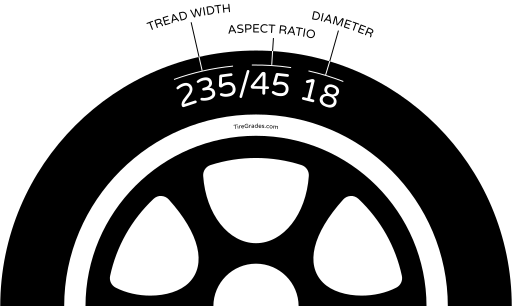
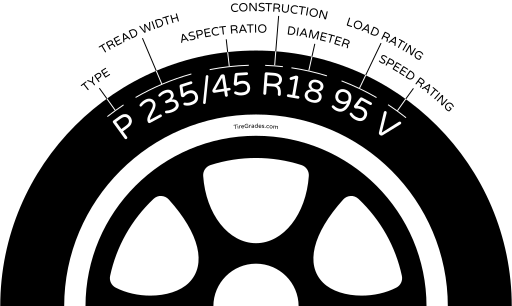
Every tire size starts with three measurements. Using P225/60R16 as an example:
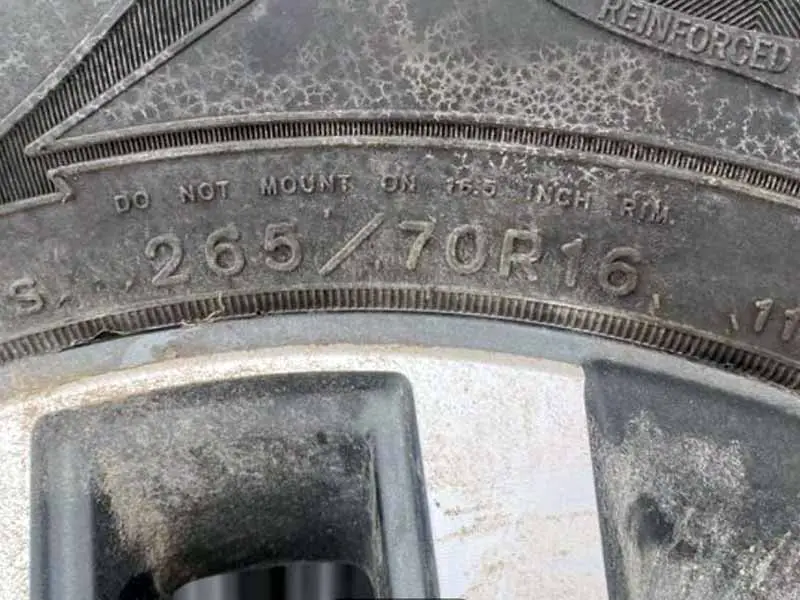
225 — Section Width (millimeters). This is the width of the tire from sidewall to sidewall when mounted and inflated. Not the tread width — the total width including the slight bulge of the sidewalls. A wider tire puts more rubber on the road, which generally means better grip. But wider also means more rolling resistance (worse fuel economy), more road noise, and potentially more susceptibility to hydroplaning since there’s more surface to evacuate water from.
60 — Aspect Ratio. This is the sidewall height expressed as a percentage of the width. In this case, the sidewall is 60% of 225mm, which equals 135mm. A lower number means a shorter sidewall — you’ll hear these called “low-profile” tires. A higher number means a taller sidewall.
This matters for ride quality. Taller sidewalls absorb more road imperfections, giving you a softer ride. Shorter sidewalls flex less, which means sharper handling and more responsive steering — but a stiffer ride that transmits every pothole into the cabin. This is the fundamental comfort-versus-performance tradeoff in tire sizing.
R16 — Construction and Wheel Diameter. The “R” means radial construction, which is virtually every passenger tire made today. The “16” is the wheel diameter in inches — this tire fits a 16-inch wheel. This number must match your wheel exactly. You cannot mount a tire designed for a 16-inch wheel on a 17-inch wheel.
How These Three Numbers Determine Overall Tire Size
The overall diameter of your tire — the distance from the ground to the top of the tread — is calculated from these three numbers combined. Width and aspect ratio determine sidewall height, and adding twice the sidewall height to the wheel diameter gives you the total diameter.
For our example: 225mm × 0.60 = 135mm sidewall height. Convert to inches: 135mm ÷ 25.4 = 5.31 inches per side. Total diameter: 16″ wheel + (5.31″ × 2) = 26.63 inches.
This is why the same wheel diameter can have dramatically different overall tire sizes. A 225/60R16 and a 225/45R16 both fit a 16-inch wheel, but the first has a 26.6-inch diameter while the second has only a 24.0-inch diameter. That difference affects your speedometer, ride height, ground clearance, and handling.
Don’t feel like doing the math. Use our Tire Size Comparison Calculator.
Tire Size Comparison Calculator
Tire Classifications: P, LT, ST, and T
Before the three numbers, most tires have a one- or two-letter classification that tells you what type of vehicle the tire is designed for.
- P (Passenger). Designed for passenger cars, minivans, crossovers, and light SUVs. These are the most common tires on the road. They prioritize ride comfort, fuel efficiency, and handling for vehicles under roughly 3/4 ton.
- LT (Light Truck). Built for heavier vehicles — full-size trucks, large SUVs, and commercial vans. LT tires have stronger sidewall construction, higher load-carrying capacity, and are rated for the demands of towing and hauling. If your vehicle has a Gross Vehicle Weight Rating over 6,000 lbs or you regularly tow, you likely need LT tires.
- ST (Special Trailer). Designed exclusively for trailer use. ST tires have stiffer sidewalls to handle the unique stresses of being pulled (lateral forces, sway) rather than driven. Never put ST tires on a vehicle that steers or drives — they’re not designed for it.
- T (Temporary). Your spare tire. Limited to 50 mph and 50 miles. Full-size temporary spares maintain the same diameter as your regular tires. Compact “donut” spares are smaller and lighter but significantly limit your driving until you replace the flat.
- No letter (Euro-Metric). Functionally identical to P-Metric tires in most cases. The difference is a slightly different load calculation methodology. If your tire has no letter prefix before the width number, it’s a Euro-Metric designation.
P-Metric vs. LT: When It Matters
This is a decision point that many SUV and truck owners get wrong. The choice between P and LT isn’t just about vehicle size — it’s about how you use the vehicle.
A mid-size SUV like a Toyota Highlander comes with P-Metric tires from the factory and that’s perfectly appropriate for how most people use them. But if you’re towing a 5,000 lb boat every weekend or loading the bed with 1,000 lbs of materials, LT tires provide the load capacity and sidewall strength to handle that stress safely.
Going the other direction — putting P-Metric tires on a vehicle that came with LT — can be dangerous if the vehicle regularly carries heavy loads. The P-Metric tire may not have the load capacity to handle the weight.
The key is matching the tire to your actual use case, not just your vehicle.
Speed Ratings
After the load index number (which we’ll cover next), you’ll see a letter — the speed rating. This indicates the maximum speed the tire is certified to sustain safely under load.
Common speed ratings and their maximums:
| Rating | Max Speed | Typical Use |
|---|---|---|
| S | 112 mph | Family sedans, minivans |
| T | 118 mph | Family sedans, some SUVs |
| H | 130 mph | Sport sedans, crossovers |
| V | 149 mph | Sports cars, performance sedans |
| W | 168 mph | High-performance sports cars |
| Y | 186 mph | Exotic and ultra-high-performance vehicles |
| Z | 149+ mph | Performance designation (often paired with W or Y) |
What Speed Rating Should You Buy?
Match or exceed your vehicle’s original speed rating. Never go lower. If your car came with H-rated tires, you can replace them with H, V, W, or Y — but not S or T.
The practical question most people ask: “Can I use V-rated tires instead of H?” Yes — going higher is always safe. A V-rated tire will handle everything an H-rated tire can, plus more. You may notice a slightly stiffer ride with a higher speed rating because the construction is more rigid, but the performance and safety are not compromised.
Going higher than necessary costs more and may sacrifice a small amount of ride comfort. A Y-rated tire on a minivan is overkill — you’re paying for performance capability you’ll never use. But it won’t cause any problems.
Do Higher Speed-Rated Tires Wear Faster?
This is a common question, and the answer is nuanced. Higher speed-rated tires tend to use softer rubber compounds for better grip at high speeds, and softer compounds wear faster. But this isn’t universal — the correlation between speed rating and tread life is weak enough that you should look at actual treadwear data (UTQG ratings and owner feedback) rather than assuming a V-rated tire will wear faster than an H-rated one.
Our tire reviews include treadwear scores for every tire, so you can compare directly rather than guessing based on speed rating.
Load Index and Load Range
These two related but distinct specifications tell you how much weight your tires can support.
Load Index
The load index is a number (usually 85–120 for passenger vehicles) that corresponds to a specific weight capacity per tire. You’ll find it right after the wheel diameter in the tire size — for example, P225/60R16 97H. That “97” is the load index.
Some common load index values:
| Load Index | Max Weight Per Tire |
|---|---|
| 91 | 1,356 lbs |
| 95 | 1,521 lbs |
| 97 | 1,609 lbs |
| 100 | 1,764 lbs |
| 105 | 2,039 lbs |
| 110 | 2,337 lbs |
| 116 | 2,756 lbs |
| 120 | 3,086 lbs |
Never install tires with a lower load index than what your vehicle specifies. The tires need to support the vehicle’s weight plus passengers, cargo, and any load you’re carrying. Your door jamb sticker or owner’s manual lists the minimum load index for your vehicle.
Load Range
Load range is primarily relevant for LT (Light Truck) tires and indicates both the tire’s load-carrying capacity and the inflation pressure required to achieve it. It’s designated by a letter:
- Load Range C — 6-ply rated. Lighter duty, suitable for lighter trucks and SUVs that don’t carry heavy loads.
- Load Range D — 8-ply rated. Mid-range capacity. Common on half-ton trucks used for moderate hauling.
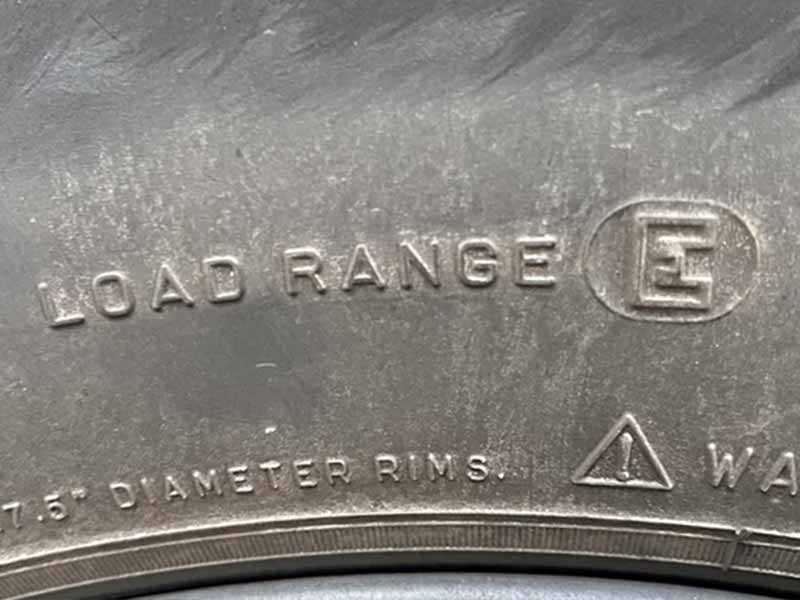
- Load Range E — 10-ply rated. Heavy-duty capacity. This is the standard for most 3/4-ton and 1-ton trucks, and for anyone who tows regularly. Load Range E tires require higher inflation pressures (typically 65–80 PSI) to support their rated loads.
- XL (Extra Load) — Used on P-Metric tires that are reinforced to carry more weight than a standard tire of the same size. Common on heavier crossovers and SUVs that use passenger tires. XL tires require slightly higher inflation pressure than standard load tires.
The “10-Ply” Confusion
Modern tires don’t actually have 10 physical plies. “10-ply rated” is a legacy designation that indicates the tire has the same load capacity as an old-style tire with 10 plies. A modern Load Range E tire achieves that capacity with advanced materials and fewer actual layers. When someone says “10-ply tires,” they mean Load Range E.
Choosing Between Load Ranges
If your vehicle came with Load Range E tires, stick with Load Range E. Downgrading to C or D reduces your load capacity and can be dangerous if you haul or tow.
If you’re choosing between C and E for a half-ton truck you don’t use for heavy work, Load Range C or D will give you a more comfortable ride with less road noise. Load Range E is stiffer and louder but handles heavier loads safely. Match the load range to how you actually use the truck, not to the most extreme thing you might hypothetically do with it once a year.
For off-road use specifically, Load Range E provides better puncture resistance due to its stronger sidewall construction. If you’re on trails with sharp rocks, the extra durability is worth the ride comfort tradeoff.
Changing Tire Sizes: What You Need to Know
This is where most people get into trouble — or miss out on a beneficial upgrade — because they don’t understand the effects.
The 3% Rule
The general guideline is to stay within 3% of your original tire’s overall diameter when changing sizes. Beyond that, you start seeing meaningful effects on speedometer accuracy, vehicle handling, and potentially interference with ABS and traction control systems.
Our Tire Diameter & Circumference Calculator shows you the exact diameter difference between any two sizes and calculates the speedometer error.
Tire Diameter & Circumference Calculator
What Happens When You Go Bigger
Larger overall diameter means your speedometer reads lower than your actual speed (you’re going faster than it says), your odometer under-counts miles, ground clearance increases slightly, fuel economy typically decreases due to increased rolling resistance and weight, and acceleration may feel slightly slower.
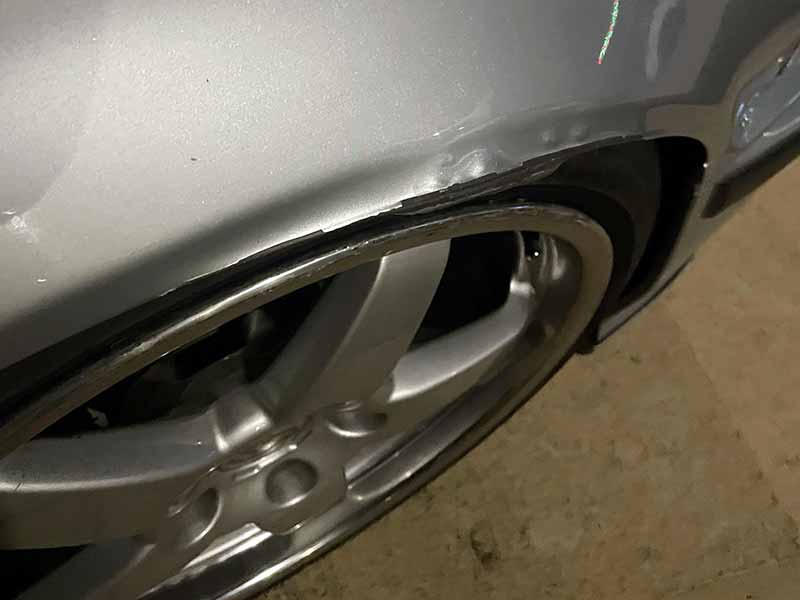
Wider tires specifically increase the contact patch (better grip in dry conditions), increase road noise, may decrease fuel economy, and can potentially rub against fenders or suspension components.
What Happens When You Go Smaller
Smaller overall diameter means your speedometer reads higher than your actual speed, your odometer over-counts miles, ground clearance decreases, and acceleration may feel slightly quicker.
Plus-Sizing: Bigger Wheels, Lower Profile
A common upgrade is to increase wheel diameter while decreasing aspect ratio to maintain roughly the same overall tire diameter. For example, going from 225/60R16 to 225/45R18. The wheel is bigger (16″ to 18″), the sidewall is shorter (60 to 45), but the overall diameter stays close to the original.
This gives you the visual appeal of larger wheels with sharper handling from the lower-profile tire, without significantly affecting your speedometer or vehicle dynamics. The tradeoff is ride comfort — shorter sidewalls transmit more road imperfections.
Matching Tires Across Axles
On most vehicles, all four tires should be the same size. Running different sizes front and rear (staggered setup) is acceptable only if your vehicle was designed for it — typically rear-wheel-drive sports cars and some performance SUVs.
On all-wheel-drive vehicles, mismatched tire sizes (even from different levels of wear) can stress the drivetrain. AWD systems rely on all four wheels having similar rolling diameters. A significant mismatch can damage the center differential or transfer case — an expensive repair. This is why AWD vehicles should always have all four tires replaced at once if possible, and why maintaining even tread depth through regular rotation is critical.
Rim Width and Tire Compatibility
Every tire size has an approved range of rim widths it can be mounted on. A 225mm tire might fit rims from 6.5″ to 8.0″ wide, with 7.0″ to 7.5″ being the ideal range.
Mounting a tire on a rim that’s too narrow causes the sidewalls to pinch inward, reducing the contact patch and creating unusual wear. Mounting on a rim that’s too wide stretches the tire, making the sidewall vulnerable to impact damage and changing the handling characteristics.
Use our Rim Width Compatible Tire Sizes Calculator to find what tire widths work with your specific wheels.
Rim Width Compatible Tire Sizes Calculator
How to Find Your Correct Tire Size
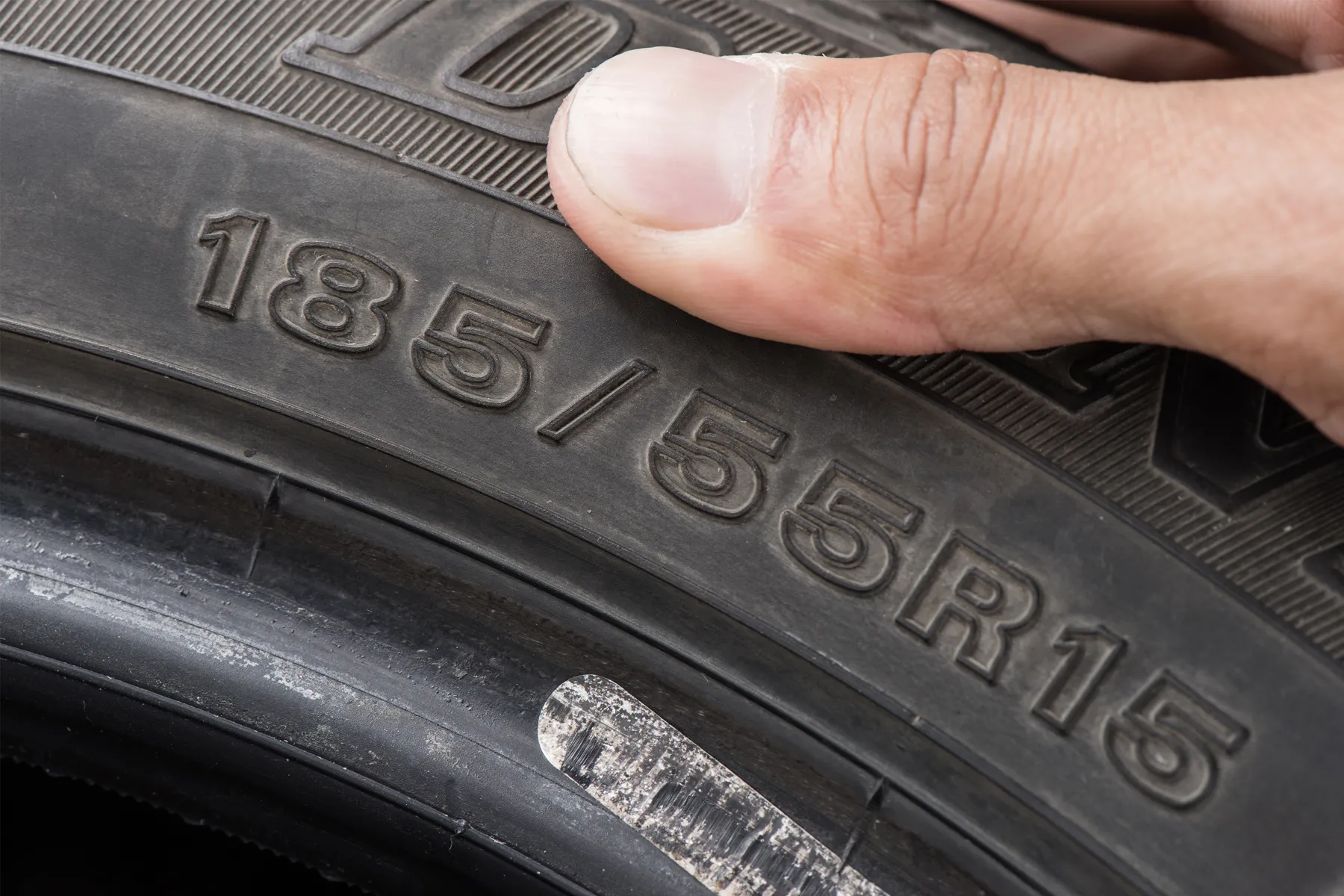
If you’re simply replacing your current tires with the same size, the easiest method is to read the size off the sidewall of your current tire. It’s molded into the rubber and looks something like P225/60R16 97H.
If you’re not sure whether your current tires are the correct size (maybe a previous owner changed them), check the tire information sticker on your driver’s side door jamb. This lists the vehicle manufacturer’s specified tire size, recommended pressure, and load capacity. Your owner’s manual has the same information.
If you’re considering a size change, start with the vehicle’s original size as your baseline and use the Tire Size Comparison Calculator to evaluate alternatives within the 3% diameter rule.
And if you just want to know which tires fit your specific vehicle and which ones we recommend, use our Vehicle Lookup Tool (at the bottom of this page) — enter your year, make, and model and we’ll show you the compatible sizes and our top-rated options.
Tools & Calculators
We’ve built several calculators specifically for tire sizing questions:
Tire Size Comparison Calculator
Compare two tire sizes side by side: diameter difference, speedometer impact, and visual comparison.
Rim Width Compatible Tire Sizes Calculator
Find which tire widths fit your specific rim width.
Tire Diameter & Circumference Calculator
Calculate the exact diameter and circumference of any tire size.
Speedometer Error Calculator
See how a tire size change affects your speedometer reading.
Tire Height Calculator
Convert metric tire sizes to overall height in inches.
Tire Aspect Ratio Calculator
Calculate sidewall height from width and aspect ratio.
Section Width Conversion Calculator
Convert between metric and inch-based width measurements.
All calculators are available on our Tire Calculators page.
Frequently Asked Questions
Q: What do the three numbers on a tire mean?
A: Width in millimeters, aspect ratio (sidewall height as a percentage of width), and wheel diameter in inches. For 225/60R16: the tire is 225mm wide, the sidewall is 60% of the width, and it fits a 16-inch wheel.
Q: Can I put a different size tire on my car?
A: Yes, within limits. Stay within 3% of your original tire’s overall diameter to avoid significant speedometer error, handling changes, and potential interference with safety systems. Use our Tire Size Comparison Calculator to check.
Q: What does the R mean in tire size?
A: Radial construction. Virtually all modern passenger and light truck tires are radial. You’ll occasionally see “D” for diagonal (bias-ply), mainly on some trailer tires.
Q: Do bigger tires affect gas mileage?
A: Generally yes — larger and wider tires increase rolling resistance and weight, which reduces fuel economy. The effect varies but expect a 1-3% decrease for a moderate size increase. The tradeoff is typically better grip and a more aggressive appearance.
Q: What’s the difference between Load Range E and XL?
A: Load Range E is an LT-tire designation indicating heavy-duty load capacity (10-ply rated). XL (Extra Load) is a P-Metric designation indicating a reinforced passenger tire that can carry more than a standard tire of the same size. They serve similar purposes — higher load capacity — but for different tire types.
Q: Is it safe to run different tire sizes on the front and rear?
A: Only if your vehicle was designed for staggered sizing. On AWD and 4WD vehicles, mismatched sizes can damage the drivetrain. On FWD and RWD vehicles, mismatched sizes affect handling balance and should only be done as designed by the manufacturer.
Q: How do I figure out what size tires are equivalent to 33-inch or 35-inch tires?
A: These “inch sizes” refer to overall diameter. Multiple metric sizes can achieve the same overall diameter depending on the width, aspect ratio, and wheel size you choose. A 33-inch tire is roughly a 285/75R16 or 275/70R17. A 35-inch tire is roughly a 315/75R16 or 295/70R17. Use our Tire Height Calculator to find exact equivalents for any target diameter.
Looking for the best tires in your size? Use our vehicle lookup to find tires that fit your specific year, make, and model — rated by real owner feedback.
Help A Friend (& Us!) By Sharing This Article
About The Author

Will Creech is the founder of TireGrades.com and has been immersed in the tire industry for over three decades. His expertise was shaped by growing up alongside the founder of Parrish Tire in Charlotte, NC, and later honed through a consulting contract with Discount Tire, where he developed training courses and strategic planning materials.
An active SCCA participant and lifelong automotive enthusiast, Will personally researches, writes, and produces every review on TireGrades — including 300+ companion video reviews on YouTube. His approach combines aggregated real-world owner data with deep industry knowledge to help drivers find the right tire at the right price.


Related Articles