
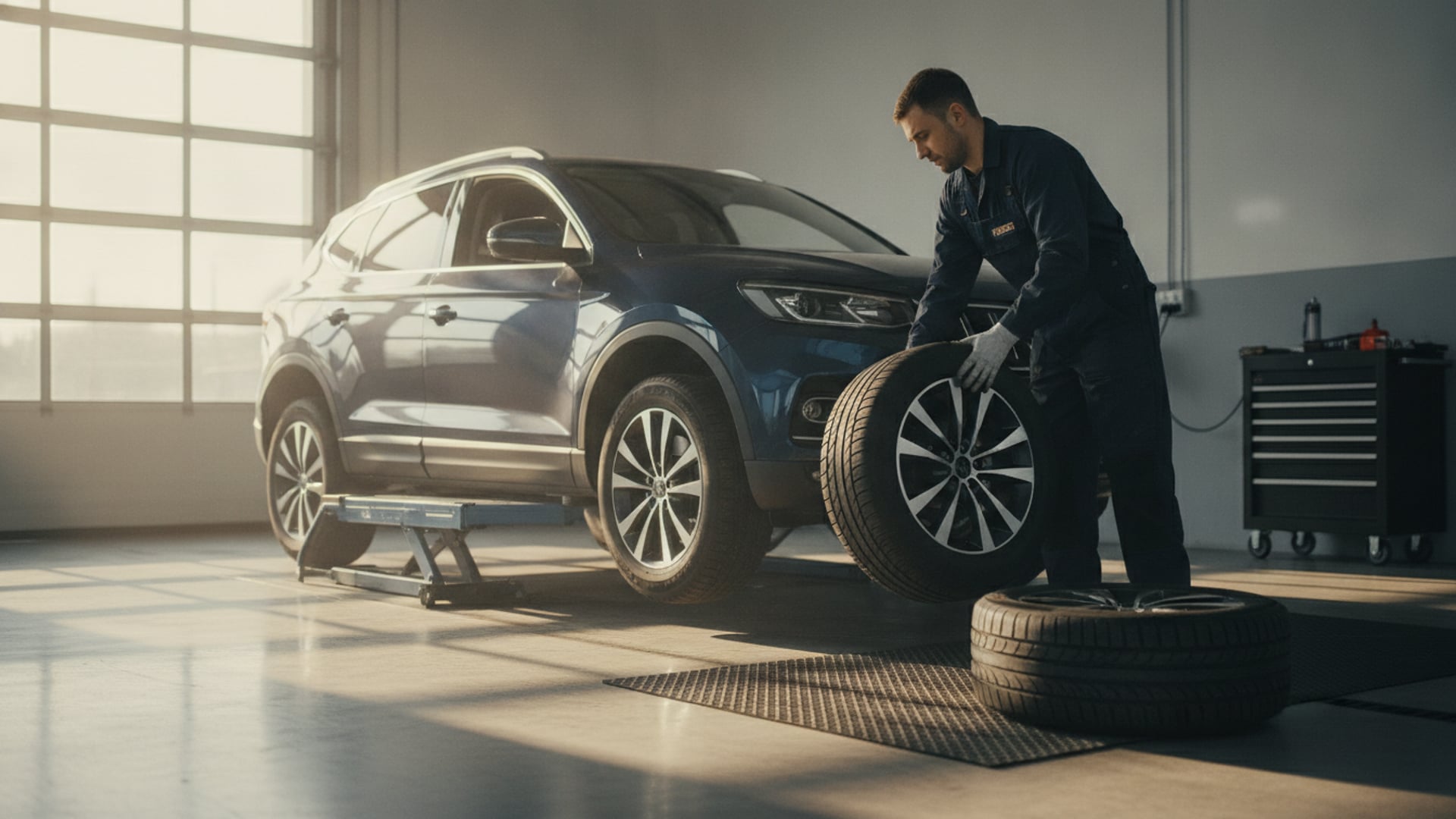
A mechanic rotating tires on an all-wheel-drive crossover SUV in a service garage

All-Wheel Drive Tire Rotation Patterns


 |  Last Updated:

Jun 24, 2026 @ 9:40 pm

Time To Read:

5 minutes

 |  Last Updated:

Jun 24, 2026 @ 9:40 pm

Time To Read:

5 minutes

The standard rotation pattern for AWD vehicles is the rearward cross: front tires move straight back to the rear, while rear tires cross forward to the opposite side. This is the pattern recommended by most AWD manufacturers because it equalizes the wear that AWD systems cause across all four tires.

AWD vehicles need rotation more frequently than front- or rear-wheel-drive cars — every 5,000 miles rather than the 7,500-mile interval common for 2WD. The reason: all four tires drive, so all four wear simultaneously. If you don’t rotate, the wear difference between tires can quickly exceed the 2–4/32″ tolerance most AWD systems require — and once it does, you’re risking expensive driveline damage.

This guide covers the standard pattern, the directional-tire alternative, when to break the routine, and why rotation matters more for AWD than anything else.

The Standard Pattern: Rearward Cross

For non-directional tires (which is most all-season and touring tires), the rearward cross pattern is recommended:

  • Left front → Left rear (straight back, same side)
  • Right front → Right rear (straight back, same side)
  • Left rear → Right front (forward and cross)
  • Right rear → Left front (forward and cross)

Each tire ends up in a different position than where it started. Over a few rotation cycles, every tire spends time at each of the four corners — equalizing the different wear profiles each position creates.

The Directional Tire Pattern: Front to Back

Directional tires (those with an arrow on the sidewall indicating rolling direction, common on performance and some winter tires) can only spin one way without losing performance. They can’t be moved side-to-side without being dismounted and remounted. For directional AWD rotations:

  • Left front → Left rear
  • Left rear → Left front
  • Right front → Right rear
  • Right rear → Right front

Less ideal than the rearward cross pattern (the tires don’t see all four positions), but it’s the only safe choice for directional tires without dismounting them.

Why AWD Needs More Frequent Rotation

In a 2WD vehicle, only two tires drive. The other two freewheel. Drive tires wear faster than freewheelers, but the difference accumulates slowly enough that 7,500-mile rotation intervals keep them within tolerance.

In an AWD vehicle, all four tires drive. They wear at similar but not identical rates depending on the AWD system’s torque distribution. After 5,000–7,500 miles, the front-to-rear wear difference can exceed 2–4/32″ — which is the threshold most AWD systems can tolerate before continuous wheel-speed mismatches start stressing the drivetrain.

The consequences of skipping rotation on AWD:

  • Viscous coupling damage (Subaru, older AWD systems) — $1,500–$3,000 to replace.
  • Transfer case wear — $1,500–$4,000.
  • Premature tire replacement — once tires are out of tolerance, you often have to replace all four together even if some still had life left.

The math is brutal: a $40 rotation prevents potentially $3,000 of driveline damage and an unexpected $800–$1,200 tire purchase. There’s almost no scenario where skipping rotation saves money long-term.

How Often to Rotate AWD Tires

  • Standard interval: every 5,000 miles. Aligns naturally with most oil change intervals on modern vehicles.
  • Subaru specifically: the manual usually specifies 7,500 miles, but every 5,000 is safer. Subaru’s AWD system is particularly sensitive to wheel-speed differences.
  • Sports cars with AWD (e.g., Audi RS, BMW M xDrive): often have staggered tire sizes (wider rear than front). These can’t be rotated in the normal pattern — rears swap with rears, fronts with fronts.
  • If you’ve gone past the interval: check tread depth across all four with a gauge. If the difference exceeds 2/32″, talk to your tire shop about whether rotation can still help or if you need to replace.

Including the Spare in Rotation

Some AWD vehicles came with a full-size matching spare. If yours did, you can include the spare in rotation using the 5-tire rotation pattern:

  • Each rotation cycle, the spare goes to one corner and one of the four mounted tires goes into the spare position.
  • Over five cycles, all five tires spend time at each position including the trunk.
  • All five wear at approximately the same rate, so you don’t end up with a much-newer spare when the main four need replacement.

This only works with a matching full-size spare. Compact spares (donut-type) can’t be rotated — they’re not designed for sustained driving.

When NOT to Rotate

  • One tire is significantly more worn than the others. Rotating moves the wear pattern but doesn’t fix the underlying cause. Diagnose first (alignment, suspension, slow leak), then rotate.
  • One tire has visible damage (gash, bulge, sidewall crack). Don’t rotate damaged tires into new positions — replace them first.
  • You’re about to replace tires anyway. If they’re nearly at 4/32″ everywhere and you’ll be at the tire shop in 2,000 miles, the rotation won’t help meaningfully.

Doing It Yourself vs. Shop

AWD rotation is straightforward DIY work if you have a jack, jack stands, and a torque wrench. The whole job takes 30–45 minutes including raising/lowering the vehicle.

  • DIY cost: free, if you have the tools.
  • Shop cost: $20–$50 per rotation. Often included free with tire purchase or as part of a service package.
  • Shop bonus: they typically check tire pressure, inspect tread for damage, and may include a brief wheel/brake visual inspection as part of the rotation.

For most owners, the small cost of a shop rotation is worth the visual inspection alone.

Bottom Line

AWD tire rotation uses the rearward cross pattern for non-directional tires (fronts move straight back, rears cross forward), or the front-to-back pattern for directional tires (each tire stays on its original side). Rotate every 5,000 miles — more frequently than 2WD vehicles need.

Skipping rotation on AWD vehicles risks expensive driveline damage and forces premature replacement of all four tires simultaneously. The $20–$50 cost of a rotation is small insurance against $1,500–$3,000 of repair work.

Related Guides

About The Author

Will Creech
Will Creech

Will Creech is the founder of TireGrades.com and has been immersed in the tire industry for over three decades. His expertise was shaped by growing up alongside the founder of Parrish Tire in Charlotte, NC, and later honed through a consulting contract with Discount Tire, where he developed training courses and strategic planning materials.

An active SCCA participant and lifelong automotive enthusiast, Will personally researches, writes, and produces every review on TireGrades — including 300+ companion video reviews on YouTube. His approach combines aggregated real-world owner data with deep industry knowledge to help drivers find the right tire at the right price.

YouTube Icon
LinkedIn icon
YouTube Icon
LinkedIn icon

The standard rotation pattern for AWD vehicles is the rearward cross: front tires move straight back to the rear, while rear tires cross forward to the opposite side. This is the pattern recommended by most AWD manufacturers because it equalizes the wear that AWD systems cause across all four tires.

AWD vehicles need rotation more frequently than front- or rear-wheel-drive cars — every 5,000 miles rather than the 7,500-mile interval common for 2WD. The reason: all four tires drive, so all four wear simultaneously. If you don’t rotate, the wear difference between tires can quickly exceed the 2–4/32″ tolerance most AWD systems require — and once it does, you’re risking expensive driveline damage.

This guide covers the standard pattern, the directional-tire alternative, when to break the routine, and why rotation matters more for AWD than anything else.

The Standard Pattern: Rearward Cross

For non-directional tires (which is most all-season and touring tires), the rearward cross pattern is recommended:

  • Left front → Left rear (straight back, same side)
  • Right front → Right rear (straight back, same side)
  • Left rear → Right front (forward and cross)
  • Right rear → Left front (forward and cross)

Each tire ends up in a different position than where it started. Over a few rotation cycles, every tire spends time at each of the four corners — equalizing the different wear profiles each position creates.

The Directional Tire Pattern: Front to Back

Directional tires (those with an arrow on the sidewall indicating rolling direction, common on performance and some winter tires) can only spin one way without losing performance. They can’t be moved side-to-side without being dismounted and remounted. For directional AWD rotations:

  • Left front → Left rear
  • Left rear → Left front
  • Right front → Right rear
  • Right rear → Right front

Less ideal than the rearward cross pattern (the tires don’t see all four positions), but it’s the only safe choice for directional tires without dismounting them.

Why AWD Needs More Frequent Rotation

In a 2WD vehicle, only two tires drive. The other two freewheel. Drive tires wear faster than freewheelers, but the difference accumulates slowly enough that 7,500-mile rotation intervals keep them within tolerance.

In an AWD vehicle, all four tires drive. They wear at similar but not identical rates depending on the AWD system’s torque distribution. After 5,000–7,500 miles, the front-to-rear wear difference can exceed 2–4/32″ — which is the threshold most AWD systems can tolerate before continuous wheel-speed mismatches start stressing the drivetrain.

The consequences of skipping rotation on AWD:

  • Viscous coupling damage (Subaru, older AWD systems) — $1,500–$3,000 to replace.
  • Transfer case wear — $1,500–$4,000.
  • Premature tire replacement — once tires are out of tolerance, you often have to replace all four together even if some still had life left.

The math is brutal: a $40 rotation prevents potentially $3,000 of driveline damage and an unexpected $800–$1,200 tire purchase. There’s almost no scenario where skipping rotation saves money long-term.

How Often to Rotate AWD Tires

  • Standard interval: every 5,000 miles. Aligns naturally with most oil change intervals on modern vehicles.
  • Subaru specifically: the manual usually specifies 7,500 miles, but every 5,000 is safer. Subaru’s AWD system is particularly sensitive to wheel-speed differences.
  • Sports cars with AWD (e.g., Audi RS, BMW M xDrive): often have staggered tire sizes (wider rear than front). These can’t be rotated in the normal pattern — rears swap with rears, fronts with fronts.
  • If you’ve gone past the interval: check tread depth across all four with a gauge. If the difference exceeds 2/32″, talk to your tire shop about whether rotation can still help or if you need to replace.

Including the Spare in Rotation

Some AWD vehicles came with a full-size matching spare. If yours did, you can include the spare in rotation using the 5-tire rotation pattern:

  • Each rotation cycle, the spare goes to one corner and one of the four mounted tires goes into the spare position.
  • Over five cycles, all five tires spend time at each position including the trunk.
  • All five wear at approximately the same rate, so you don’t end up with a much-newer spare when the main four need replacement.

This only works with a matching full-size spare. Compact spares (donut-type) can’t be rotated — they’re not designed for sustained driving.

When NOT to Rotate

  • One tire is significantly more worn than the others. Rotating moves the wear pattern but doesn’t fix the underlying cause. Diagnose first (alignment, suspension, slow leak), then rotate.
  • One tire has visible damage (gash, bulge, sidewall crack). Don’t rotate damaged tires into new positions — replace them first.
  • You’re about to replace tires anyway. If they’re nearly at 4/32″ everywhere and you’ll be at the tire shop in 2,000 miles, the rotation won’t help meaningfully.

Doing It Yourself vs. Shop

AWD rotation is straightforward DIY work if you have a jack, jack stands, and a torque wrench. The whole job takes 30–45 minutes including raising/lowering the vehicle.

  • DIY cost: free, if you have the tools.
  • Shop cost: $20–$50 per rotation. Often included free with tire purchase or as part of a service package.
  • Shop bonus: they typically check tire pressure, inspect tread for damage, and may include a brief wheel/brake visual inspection as part of the rotation.

For most owners, the small cost of a shop rotation is worth the visual inspection alone.

Bottom Line

AWD tire rotation uses the rearward cross pattern for non-directional tires (fronts move straight back, rears cross forward), or the front-to-back pattern for directional tires (each tire stays on its original side). Rotate every 5,000 miles — more frequently than 2WD vehicles need.

Skipping rotation on AWD vehicles risks expensive driveline damage and forces premature replacement of all four tires simultaneously. The $20–$50 cost of a rotation is small insurance against $1,500–$3,000 of repair work.

Related Guides

About The Author

Will Creech
Will Creech

Will Creech is the founder of TireGrades.com and has been immersed in the tire industry for over three decades. His expertise was shaped by growing up alongside the founder of Parrish Tire in Charlotte, NC, and later honed through a consulting contract with Discount Tire, where he developed training courses and strategic planning materials.

An active SCCA participant and lifelong automotive enthusiast, Will personally researches, writes, and produces every review on TireGrades — including 300+ companion video reviews on YouTube. His approach combines aggregated real-world owner data with deep industry knowledge to help drivers find the right tire at the right price.

YouTube Icon
LinkedIn icon
YouTube Icon
LinkedIn icon