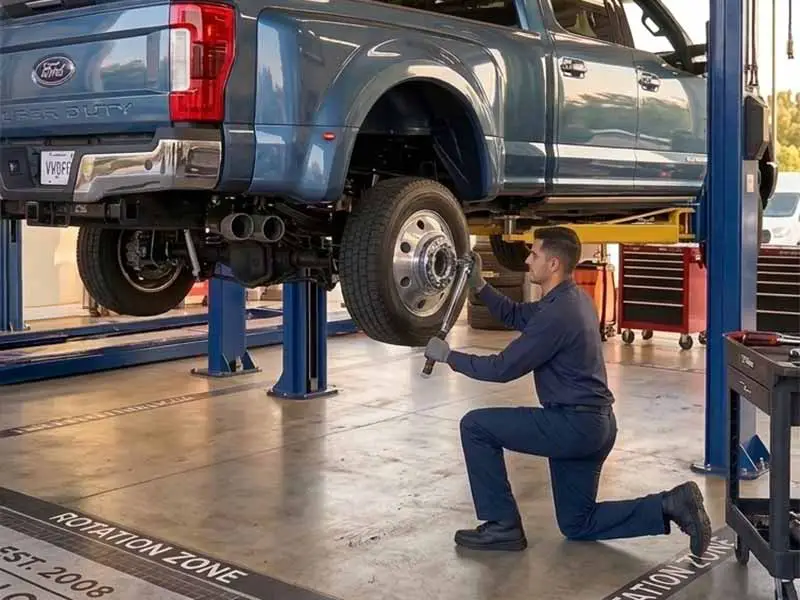
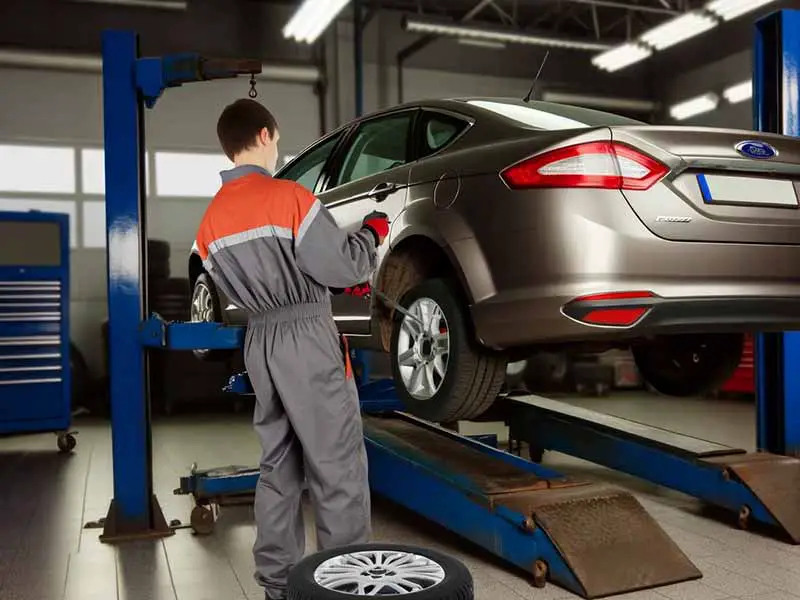
Tire rotation is the single most cost-effective maintenance you can do for your tires. It costs little or nothing at most tire shops, takes 20 minutes, and can extend your tire life by 20% or more. It’s also required to maintain nearly every tire mileage warranty — skip it, and you void your warranty.
Despite all that, it’s one of the most commonly skipped maintenance items. Most people either forget, don’t know how often to do it, or don’t realize which rotation pattern their vehicle needs.
This guide covers everything: which rotation pattern to use for your specific drivetrain, how often to rotate, how to handle special cases like directional tires and staggered wheels, when to include a spare tire, and common problems that can come from skipping rotations.
Why Tire Rotation Matters
Every position on your vehicle wears tires differently. The front tires on a front-wheel-drive car handle steering, acceleration, and most of the braking force — they wear significantly faster than the rears. The rear tires on a rear-wheel-drive truck bear the acceleration forces and tend to wear more on their inner edges due to suspension geometry.
Without rotation, you end up with two tires that are nearly worn out and two that have plenty of life left. That means you’re either replacing all four before the rears are used up (wasting money) or running mismatched tread depths (compromising handling and safety). Neither is a good outcome.
Regular rotation distributes wear evenly across all four tires, which means they all reach the end of their life at roughly the same time, they maintain more consistent handling and traction throughout their lifespan, ride comfort and noise stay more consistent as the tires age, and your mileage warranty remains valid.
The difference isn’t small. I’ve seen cases where regular rotation adds 15,000 to 20,000 miles to a set of tires compared to never rotating. On a set of $800 tires, that’s hundreds of dollars in extra value for a few minutes of maintenance.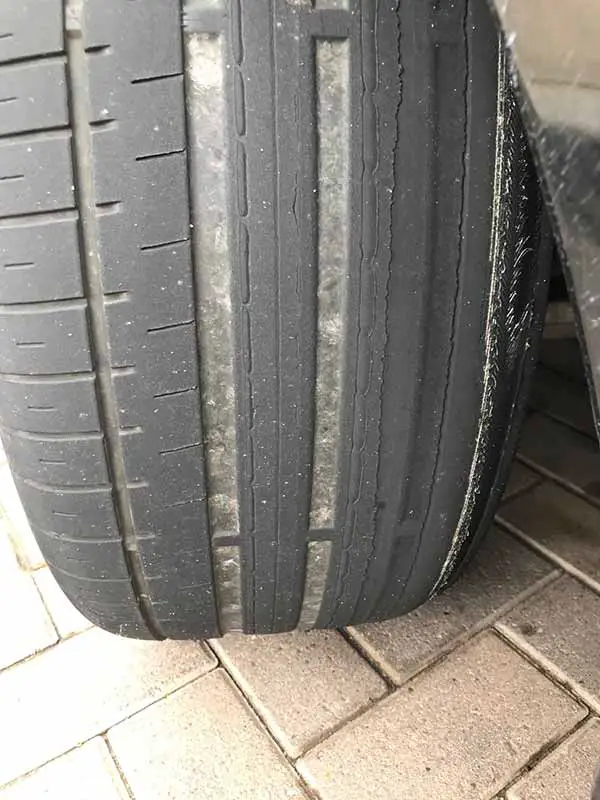
How Often to Rotate
Every 5,000 to 7,500 miles. This is the industry standard recommendation and what virtually every tire manufacturer requires for warranty purposes.
The easiest way to remember: rotate your tires every other oil change if you’re on a 3,000-5,000 mile oil change interval, or with every oil change if you’re on a 7,500-10,000 mile synthetic oil interval.
Some people ask whether you can rotate too often. Technically no — more frequent rotation just means more even wear. But the incremental benefit of rotating every 3,000 miles versus every 5,000 miles is minimal. Stick with 5,000-7,500 and you’ll be fine.
If you notice uneven wear developing between rotations, that’s usually a sign of an alignment or inflation problem — not a rotation frequency problem. Get the root cause fixed rather than trying to compensate with more frequent rotation.
Rotation Patterns: Which One for Your Vehicle

The right rotation pattern depends primarily on your drivetrain. Here’s the simple version:
- Front-wheel drive → Forward Cross (preferred) or X-Pattern
- Rear-wheel drive → Rearward Cross (preferred) or X-Pattern
- All-wheel drive → Rearward Cross (preferred) or X-Pattern
- 4-wheel drive → Rearward Cross (preferred) or X-Pattern
The X-Pattern works for any drivetrain, which makes it a solid universal fallback if you’re unsure. But the cross patterns are slightly better because they ensure every tire eventually rotates to every position on the vehicle over multiple rotations — the X-Pattern only ever swaps each tire between two positions.
Let me break down exactly what each pattern does.
Forward Cross (Front-Wheel Drive)
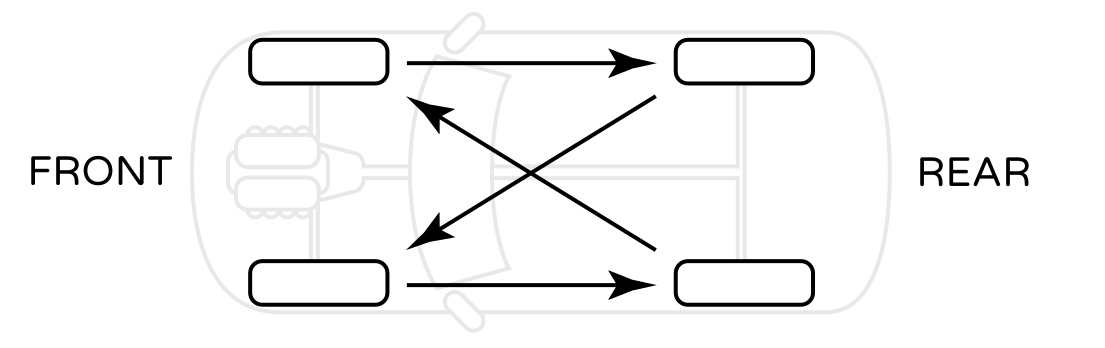
The forward cross is the preferred pattern for front-wheel-drive vehicles. It addresses the primary wear problem of FWD — the front tires wearing significantly faster than the rears.
How it works: The rear tires move to the front and cross to opposite sides — the driver’s side rear goes to the passenger’s side front, and the passenger’s side rear goes to the driver’s side front. The front tires move straight back without crossing — the driver’s side front goes to the driver’s side rear, and the passenger’s side front goes to the passenger’s side rear.
Why this works for FWD: The rear tires, which have worn more slowly and evenly, move to the front where they’ll provide fresh grip for steering and braking. The front tires, which have worn more aggressively, move to the less demanding rear positions. The cross ensures tires don’t just shuttle back and forth between the same two positions.
Rearward Cross (RWD, AWD, 4WD)
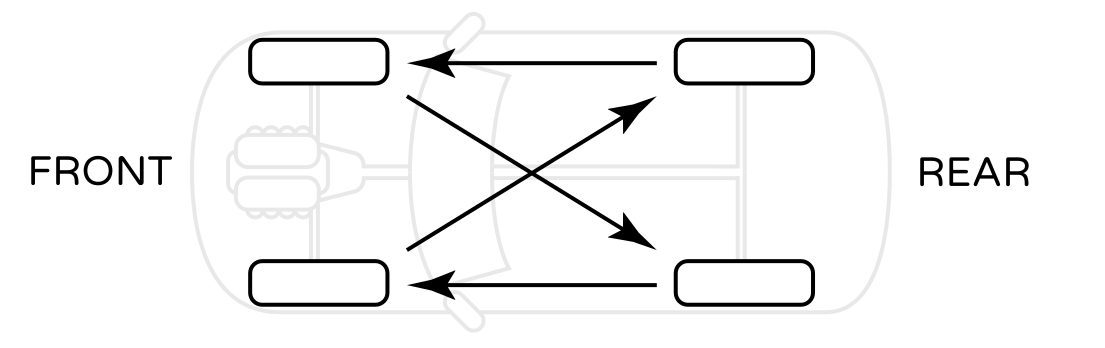
The rearward cross is the preferred pattern for rear-wheel-drive, all-wheel-drive, and four-wheel-drive vehicles. It’s essentially the mirror image of the forward cross.
How it works: The front tires move to the rear and cross to opposite sides — the driver’s side front goes to the passenger’s side rear, and the passenger’s side front goes to the driver’s side rear. The rear tires move straight forward without crossing — the driver’s side rear goes to the driver’s side front, and the passenger’s side rear goes to the passenger’s side front.
Why this works for RWD/AWD/4WD: These vehicles tend to wear rear tires faster (or more unevenly). The rearward cross takes the front tires, which have worn more evenly, and moves them to the higher-wear rear positions. AWD vehicles often have a rear-wheel-drive bias, which is why they use the same pattern as RWD.
X-Pattern (Any Drivetrain)
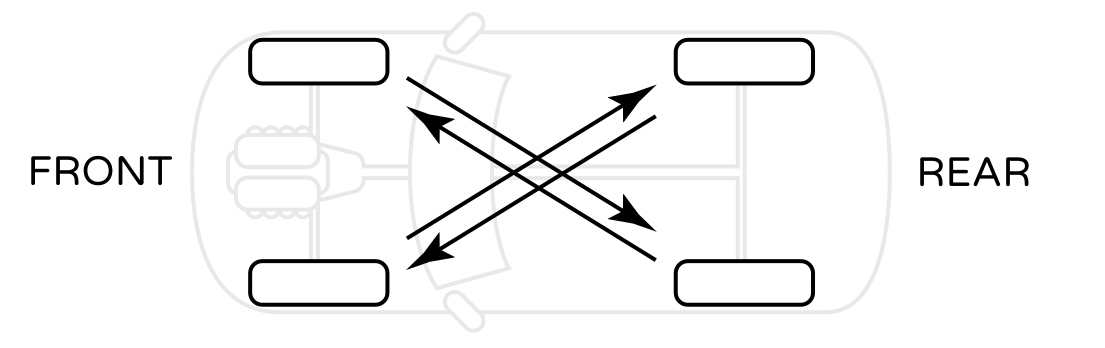
The X-Pattern is the universal option. It works for any vehicle but doesn’t quite match the cross patterns in terms of long-term wear distribution.
How it works: Every tire moves to the opposite corner. Driver’s side front swaps with passenger’s side rear. Passenger’s side front swaps with driver’s side rear.
Why it’s universal but not optimal: The X-Pattern effectively cross-rotates tires on both axles simultaneously. The downside is that each tire only ever occupies two of the four positions — it never works its way around to all four corners. Over many rotations, the cross patterns achieve more thorough wear distribution.
That said, the difference between the X-Pattern and the “correct” cross pattern is small. If your tire shop uses the X-Pattern on your vehicle, it’s not worth losing sleep over. Any rotation is dramatically better than no rotation.
Front-to-Rear (Directional Tires Only)
How it works: Front tires move straight back to the rear. Rear tires move straight forward to the front. No tires cross sides.
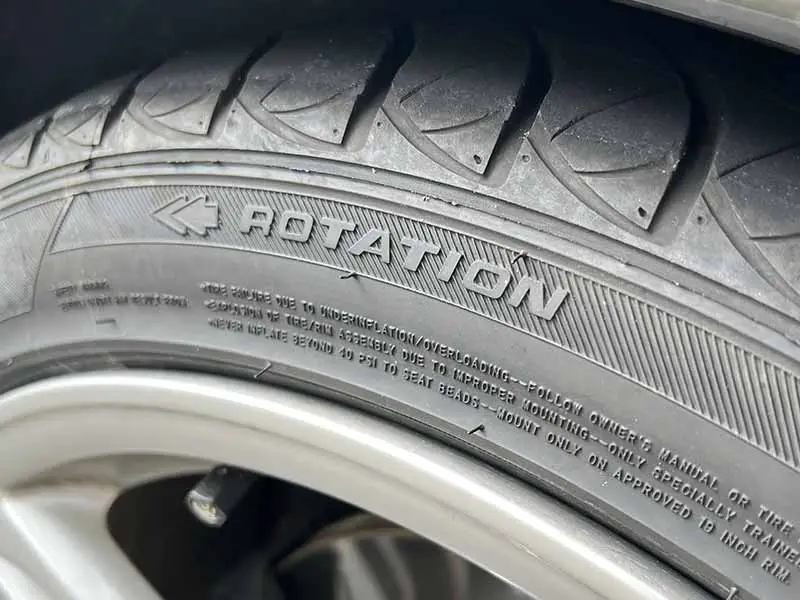
When to use it: Only when you have directional tires. Directional tires have a V-shaped tread pattern designed to channel water in one direction — they have an arrow on the sidewall indicating which way they must rotate. Once mounted on a wheel, a directional tire can only be used on one side of the vehicle. Moving it to the opposite side would make it spin backward, which defeats the tread design and can be dangerous in wet conditions.
Front-to-rear is the most limited rotation pattern. You don’t get the benefit of cross-rotation, so wear distribution isn’t as thorough. But it’s significantly better than not rotating at all, and it’s your only option with directional tires (unless you’re willing to have them dismounted and remounted on different wheels, which is expensive and impractical).
Side-to-Side (Staggered Wheels Only)

How it works: The driver’s side front swaps with the passenger’s side front. The driver’s side rear swaps with the passenger’s side rear. No tires change axles.
When to use it: Only when you have staggered wheels — meaning the front and rear wheels/tires are different sizes. This is common on rear-wheel-drive sports cars and some performance SUVs where wider rear tires provide better acceleration traction and cornering grip.
Side-to-side rotation provides the least benefit of any pattern. The wear difference between the driver’s and passenger’s side of the same axle is relatively small. However, it does help even out minor inconsistencies, and some rotation is always better than none.
If you have staggered wheels with directional tires, you’re in the most limited scenario — you essentially can’t rotate at all without dismounting and remounting tires. In this case, regular alignment checks and proper inflation become even more critical for maximizing tire life.
Including a Spare Tire (5-Tire Rotation)
If you have a full-size spare tire mounted on a wheel that matches your other four wheels, including it in your rotation is one of the smartest moves you can make. It’s relatively uncommon — mostly seen on trucks, SUVs, and vehicles like Jeep Wranglers — but the benefits are substantial.
Why Include the Spare
Your tires last 20-25% longer. Instead of wearing down four tires, you’re distributing wear across five. The math is straightforward — five tires sharing the work last longer than four.
Your spare stays road-ready. A spare tire that sits unused for years can develop dry rot, lose air pressure, and potentially fail when you actually need it. Regular rotation keeps the spare in service and properly maintained.
You’ll know if it has a problem. If the spare has a slow leak, a balance issue, or damage you didn’t notice, you’ll discover it during normal driving rather than when you’re stranded on the side of the road.
5-Tire Forward Cross (FWD)
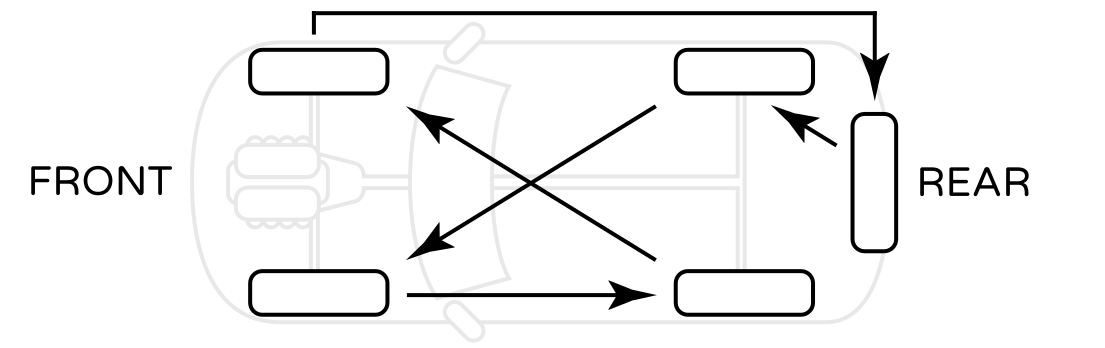
This is the standard forward cross with one modification: instead of the passenger’s side front tire moving to the passenger’s side rear, it moves to the spare position. The spare tire goes into service at the passenger’s side rear position.
5-Tire Rearward Cross (RWD, AWD, 4WD)
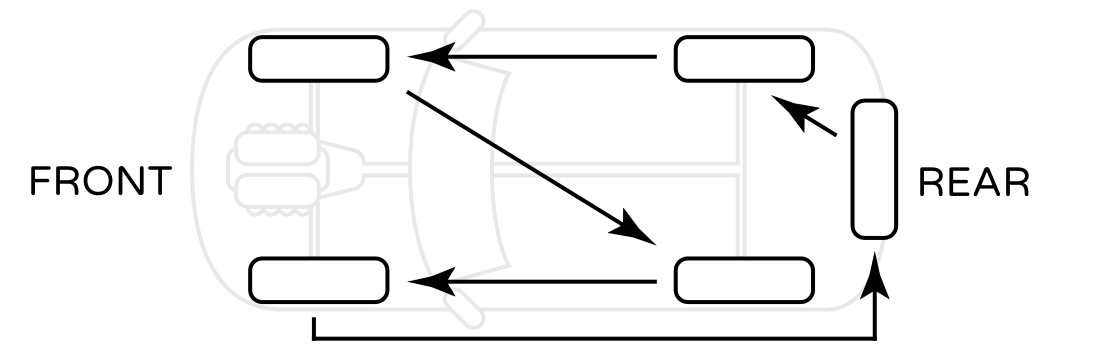
Same concept, mirror image: the driver’s side front tire moves to the spare position instead of the passenger’s side rear, and the spare goes into service at the passenger’s side rear.
Important Notes on 5-Tire Rotation
The spare’s wheel must match the other four. If your spare is mounted on a different style wheel with a different offset, the handling characteristics could change noticeably when the spare is in service. Cosmetic differences are fine — dimensional differences are not.
Do not include temporary or “donut” spares. These compact spares are designed for emergency use only, not regular driving. They have different speed ratings, load ratings, and tread depths than your regular tires.
If your spare is labeled “Temporary Use” on the sidewall, even if it’s full-size, don’t include it in rotation. It’s not built for sustained use.
Asymmetrical vs. Directional: What You Need to Know
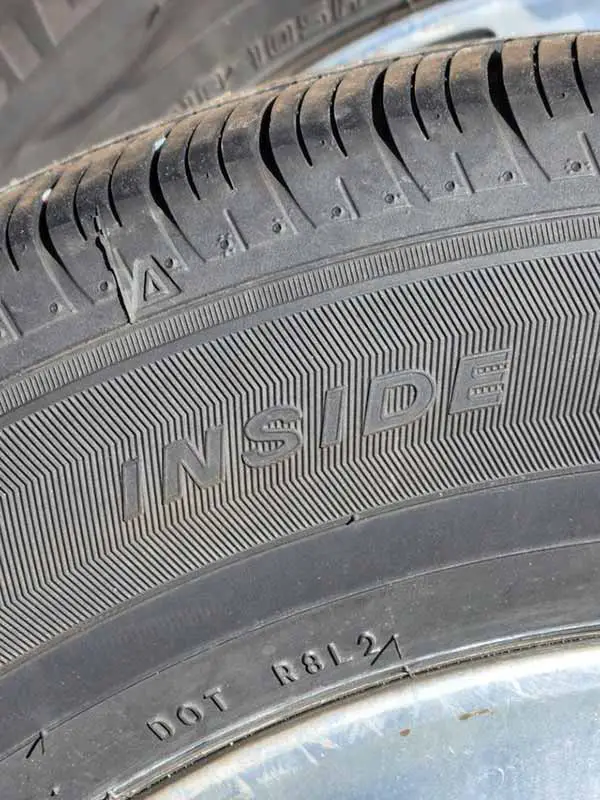
This is one of the most common points of confusion, so let me clear it up.
Asymmetrical tires have different tread patterns on the inner and outer portions of the tire. You’ll see “Outside” stamped on one sidewall. As long as the tire is mounted on the wheel with the correct side facing out, it can be rotated using any standard pattern — forward cross, rearward cross, X-Pattern, side-to-side. There are no rotation restrictions with asymmetrical tires. Most high-performance and UHP all-season tires are asymmetrical.
Directional tires have a V-shaped tread pattern designed to channel water in one direction. You’ll see an arrow on the sidewall indicating the required direction of rotation. Once mounted on a wheel, the tire is locked to one side of the vehicle. It can only be rotated front-to-rear, not cross-rotated. Winter tires and some performance tires are commonly directional.
The key difference: Asymmetrical is about which side of the tire faces out. Directional is about which direction the tire spins. Asymmetrical tires have full rotation flexibility. Directional tires are limited to front-to-rear only.
If you’re not sure which type you have, check the sidewall. An arrow means directional. “Outside” marking means asymmetrical. Many tires are neither — standard symmetrical tires with no rotation restrictions at all.
Common Problems from Skipping Rotation
Uneven Wear Leading to Early Replacement
The most expensive consequence. Without rotation, front tires on a FWD vehicle can wear out 10,000-15,000 miles before the rears. You either replace just two (creating a tread depth mismatch) or replace all four (wasting the remaining life on the rears). Either way, you’re spending money you didn’t need to spend.
Voided Mileage Warranty
Nearly every tire mileage warranty requires documented regular rotation at manufacturer-specified intervals. No rotation records means no warranty claim, even if the tires wore out prematurely due to a defect. Keep your service records.
Vibration and Noise
Tires that wear unevenly develop irregular surfaces — cupping, scalloping, and feathering. These irregular surfaces cause vibration and noise that can’t be fixed by balancing. Once an uneven wear pattern has developed, it’s permanent. Rotation prevents the uneven wear from developing in the first place.
Does Rotation Affect Alignment?
No. Tire rotation does not change your alignment. However, if your tires show uneven wear after rotation, it can reveal an alignment problem that was previously hidden because the wear pattern was developing gradually on tires that stayed in one position.
If your vehicle pulls to one side or your steering wheel is off-center after a rotation, the rotation didn’t cause it — it just made an existing alignment issue more noticeable. Get an alignment check. [Link: Tire Alignment Guide → /tire-alignment-guide/]
Does Rotation Require Rebalancing?
Not always. A standard rotation doesn’t require rebalancing unless you’re experiencing vibration. However, many tire shops include a balance check with rotation — and if they notice a wheel is out of balance, they’ll correct it. If you’re paying for rotation and balance as a package, it’s good preventive maintenance.
Doing It Yourself
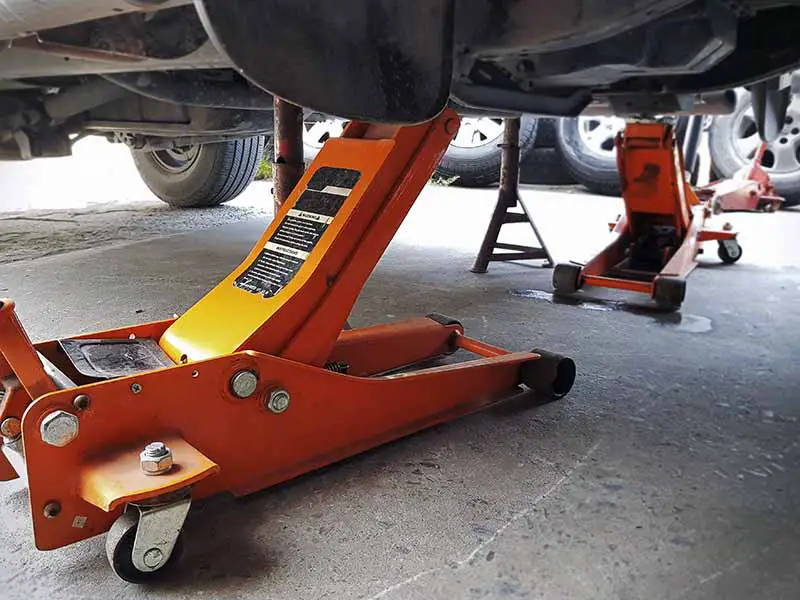
Rotating your tires at home is straightforward if you have basic equipment. You’ll need a jack (your vehicle’s jack works but a floor jack is faster and safer), two jack stands at minimum (four is better), and a lug wrench or impact wrench.
The process is simple: lift one axle, remove the tires, place them in their new positions according to the correct pattern for your drivetrain, and torque the lug nuts to spec. If you’re doing a 5-tire rotation with a spare, the process is even easier — you always have a free wheel to work with, so you only need one jack stand at a time.
One critical safety note: Never work under a vehicle supported only by a jack. Always use jack stands. This isn’t optional — jacks can fail, and the consequences are fatal.
TPMS After Rotation
If your vehicle has a direct TPMS system (most vehicles 2008 and newer), each sensor is assigned to a specific wheel position — the system knows which tire is front left, front right, rear left, and rear right. When you rotate tires, the sensors move with them, which means the system now thinks your front left tire is in the rear right position, and so on.
Some vehicles handle this automatically — they detect the new sensor positions and reassign them within a few minutes of driving. Many Toyotas, Hondas, and newer vehicles from most manufacturers self-learn without any intervention.
Others require a manual relearn procedure. This can be as simple as pressing a TPMS reset button (often located under the steering column or in the glove box), holding it until the TPMS light blinks, and then driving for a few minutes. Some vehicles require a specific relearn sequence where you trigger each sensor in a particular order using a TPMS activation tool — a handheld device that sends a signal to each sensor to tell the car’s computer which position it’s now in. These tools cost $20–40 and are worth owning if you rotate your own tires regularly.
Check your owner’s manual for your vehicle’s specific relearn procedure. If you skip this step, the TPMS will still warn you about low pressure — but it may display the warning on the wrong tire position, which can send you chasing a pressure problem on a tire that’s fine while the actual low tire goes unaddressed.
If your vehicle has an indirect TPMS system (which uses wheel speed sensors rather than pressure sensors inside the tires), there’s no sensor to reassign. However, you may still need to reset the system so it recalibrates to the new tire positions. This is usually done through a menu in your dashboard settings or by pressing a reset button.
If you’re not comfortable doing this yourself, most tire shops offer rotation for free or at low cost — especially if you purchased your tires there. Discount Tire, Costco, and many independent shops rotate tires for free regardless of where you bought them, and they’ll handle the TPMS relearn as part of the service.
Frequently Asked Questions
Q: How do I know if my tires have been rotated?
A: If you’re having it done at a shop, ask for documentation — most shops record rotations in their system and can provide a receipt. If you’re checking after the fact, the easiest way is to mark one tire with a small dot of paint or chalk before the rotation and see where it ends up. You can also check tread depth at each position — if the front tires have noticeably less tread than the rears on a FWD vehicle that’s been driven for a while, they probably haven’t been rotated recently.
Q: I forgot to rotate my tires. What happens?
A: Nothing catastrophic in the short term. Just schedule a rotation as soon as you can. If it’s been 10,000-15,000 miles since your last rotation, you’ll likely see a noticeable tread depth difference between front and rear. Getting back on a regular schedule from here will help, though you’ve already lost some potential tire life from the uneven wear.
If it’s been the entire life of the tires and they’re approaching replacement, there’s no point in rotating now — just start fresh with proper rotation on the new set.
Q: Does rotating tires really help that much?
A: Yes. The wear difference between front and rear positions on most vehicles is significant enough that rotation meaningfully extends tire life. It’s not a marginal improvement — it’s the difference between getting 45,000 miles and 60,000 miles from the same set of tires in many cases.
Q: Can I rotate my tires too often?
A: No, but the incremental benefit drops off quickly. Rotating every 5,000 miles versus every 3,000 miles makes very little practical difference. Stick with the standard 5,000-7,500 mile interval.
Q: My tires are wearing unevenly even though I rotate regularly. What’s wrong?
A: If rotation is consistent and the wear is still uneven, the cause is almost certainly alignment, inflation, or suspension. Check your alignment and tire pressure first. If those are fine, have the suspension inspected for worn components. Rotation can’t fix problems it didn’t cause — it can only prevent the uneven wear that results from normal position-based wear differences.
Q: Do I need to rotate my winter tires separately?
A: Yes, if you swap between winter and all-season/summer tires seasonally. Each set should be rotated within its own set. A good practice is to rotate each time you swap — mount them in different positions each fall and spring.
Q: How to rotate tires on a Dually?
A: Glad you asked! We have an entire article on dually tire rotation since it’s far more indepth than would appropriate to cover here. Be sure and check it out.
Looking for tires with excellent tread life? Every tire review on TireGrades includes treadwear ratings based on real owner feedback. Browse our tire reviews or use our vehicle lookup to find tires rated for longevity.
Help A Friend (& Us!) By Sharing This Article
About The Author

Will Creech is the founder of TireGrades.com and has been immersed in the tire industry for over three decades. His expertise was shaped by growing up alongside the founder of Parrish Tire in Charlotte, NC, and later honed through a consulting contract with Discount Tire, where he developed training courses and strategic planning materials.
An active SCCA participant and lifelong automotive enthusiast, Will personally researches, writes, and produces every review on TireGrades — including 300+ companion video reviews on YouTube. His approach combines aggregated real-world owner data with deep industry knowledge to help drivers find the right tire at the right price.


Related Articles